[For those not up on their music notation, "breve" refers to a half note, a l'Americaine--the oval with a stem going up or down--in a piece of music fast enough that it's easier to count half notes than quarter notes--filled-in ovals with stems--but the whole point of the title is that I don't have any more time--but do read the rest of the note after clicking on the link below.]
The service was built around our contemporary, guitar-based Praise Team. I still wanted some organ presence, so I played a meditative piece that references How Great Thou Art (O Store Gud) for prelude, and wrote a variation of the closing song, Shout to the Lord, for postlude. At the offering, my wife Marianne sang my setting of the ubiquitous Footprints in the Sand poem of greeting card/wall poster/coffee mug/et cetera fame. I provided some background vocals and played piano (a quasi finger-picking style--as much as the piano can handle that particular guitar idiom).
We're down to the wire, and may soon start intruding on sleep time, as we do our usual last-minute rush to the finish line. We still have 9 hours until we leave for the airport: plenty of time to pack...and at least nap a couple of hours...and although the packing is not my favorite part of the trip, there is plenty else to look forward to that is...
music to my ears.
Monday, October 10, 2005
alla breve


Thursday, October 06, 2005
a short note
The other piece, a tocatta-style chorale prelude on Shout to the Lord, came about as a result of my trying to find some organ music to fit in with Sunday's service, which features the guitar-supported Praise Team. I wanted to have something that harkened back to traditional for those who like the usually more even mixture of styles in our service, and yet I didn't want the organ to seem as though it had no connection to the rest of the service. I already had a prelude: a reflective setting of How Great Thou Art, which I wrote a while back. None of my existing music seemed to do for postlude. Rather than keeping digging until I unearthed something, I impulsively decided to write a piece based on the closing song.
I gave the church secretary my title, after playing around a bit on the organ and developing an opening idea. I'm trying the finished piece out today, so I'll report on it soon.
It was nice to have cousin Michael drop by, even if he wrote me a note directly rather than commenting. I expect to have a post from him soon about his musical and other adventures in Norway (far from his usual San Francisco haunts).
As usual, all this is music to my ears.
Friday, September 30, 2005
simple is not easy
I had a practice session this afternoon for a wedding, so I brought my new piece along. I really needed to do this, since I am scheduled to play the piece on Sunday. Yeah, I know I'm doing it backwards: I first schedule me to play a piece that doesn't yet exist, then I write the piece and scramble a bit learning it so I can do justice to the music! I thought I had it made this time. I deliberately stayed simple. But it turns out that fitting simple things together--they occur concurrently--results in a sum that is more complicated than the individual parts would suggest.
I suppose that, if I just wanted to slop my way through, it would be no big deal. But I wanted the piece to be expressive, and on an organ that means that articulation--whether a note is played short and crisp or smooth and connected to its neighbors--is real important.
So it turned out that my simple piece (less than and hour and a half to write almost 4 minutes of solo organ music)...wasn't simple. I've known about that contradiction in other domains--a good children's book or other art for children can be quite challenging to create. Writing an interesting piece for a beginning musician is hard to do--you don't want to fall into cliche or mindless sound.
The piece sounds neat! (What else would I say?) It's better than the mp3 I made from the notation file. I'm looking forward to another practice session tomorrow, as I still have a couple of coordination problems (one hand plays smoothly while the other plays crisply as the bass continues its relentless step - step - step), but I think I'll be able to iron them out. I'll play the piece as part of my wedding prelude (generally 30 minutes of music before the ceremony itself starts) so that its official premiere will go smoothly; I would like to work out any first-performance jitters as well as offer what I hope will be perceived as something special--assuming that anyone even notices!
As usual, it's music to my ears...
Sunday's Coming
I had this bright idea to ask a flautist in the congregation if she would like to play one of my settings of Jesus Loves Me. We're focusing on children this Sunday in conjunction with World Communion Sunday, and JLM is one of the hymns. She liked the idea, but the timing wasn't quite right in her life. In the meantime, I'd committed to JLM in the bulletin. So I got up this morning and wrote down what's really an improv on the tune.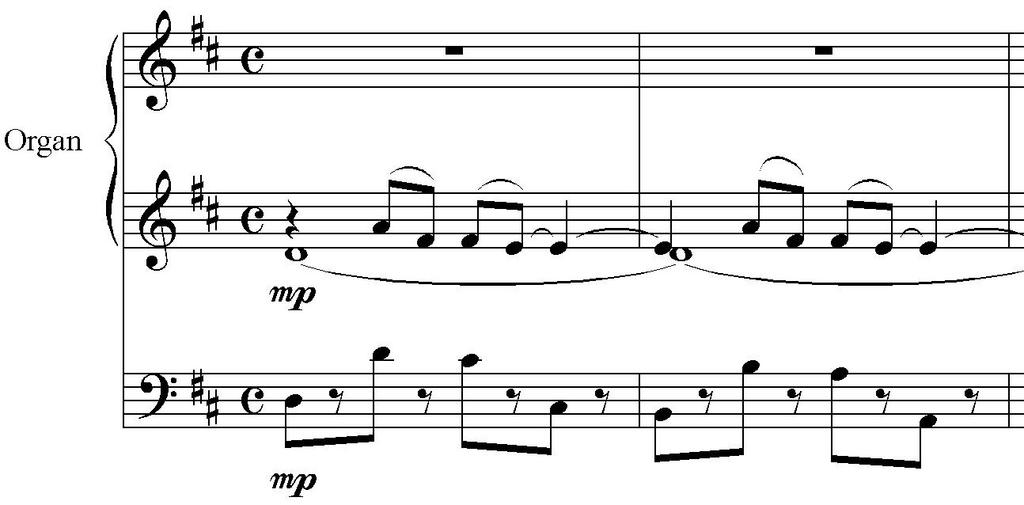 I started with a walking bass. My example shows the first half of the pattern, which just keeps repeating. [Note to Dan and others who like to hear things: here's the link to the mp3 of the whole piece.] The left hand has a simple pattern based on the first four notes of the tune. It also keeps repeating. That didn't take long! Now all I need is a bit of melody.
I decided to ornament the melody a bit. Enough so the tune gets elaborated, but not so much that the tune gets lost in the lettuce. Or broccoli. Or salad dressing. Whatever. The tune starts quite simply, as my second excerpt shows. Except for the first two notes, this first piece of melody presents the tune pretty straightforwardly. In order to make things more interesting (at least for me as composer) I decided that each each chunk of melody would be responsible for four measures, even though in its original form it is only two measures long. And then I made the measures four beats long, rather than the two of the original. It meant I had to figure out how to fill more time, and yet make sure that the connection of the material I wrote to the original tune was clear.
There's an interesting musical problem inherent in the procedure I applied here: there's no real harmonic progression or direction. Or rather, the walking bass implies motion, as it heads down the scale, makes a slight turn, and begins again just as it reaches home. But while the bass suggests motion, the sustain note in the left hand and the short repeated rif suggest a kind of stasis. Even with all the motion of the bass, and a fairly active melody line, there's almost a timeless aspect to the piece.
The lack of harmony and constant rhythmic repetition of the bass and left hand places the responsibility for the shape of the piece firmly on the melodic line. I haven't had a chance to practice the piece yet, but I think that I'll have to focus on the melody to keep the piece moving--or is it enough that these elements are just there? Although my recording suggests only one tone color for the melody, I have in mind alternating between a flute and a reed sound.
I gotta tell you that it felt good to be doing this again: write a piece Friday morning that I'll play on Sunday (well, I got the left hand/bass ideas Thursday evening right before choir practice). I'd been a little down about the rather reduced organ I now play, compared to the instrument at my previous church. Clearly, size is less important than making use of what you've got...
Which is, of course, music to my ears.
Tuesday, September 27, 2005
North north, or finding oneself
Where was my music? Not the hard copy: I have plenty of files, piles and even a stray box or two. I often have several different versions of a piece, sometimes including the original pencil manuscript (either pre-computer or at some stage in the process). I rarely throw any of it away. That would be like losing part of myself! So where was I, computationally speaking?
I've been using personal computers since our first Apple II plus (with the extra 16K card). Made some fun music on it. Switched to a Mac in 1985 with a decent music notation program and never looked back. Through generations of computers and notation programs I tried to bring my finished pieces along. I had to redo stuff when I switched from Composer to Finale. And then (sob) I succumbed to the importunings of a certain important person in my life and got a Windows machine.
I'd made the shift from floppies to CDs pretty well. A lot of stuff was archived on a whole bunch of floppies. Even with CDs I could still go back and retrieve something if I needed it. I had a neat little program that catalogued the contents of said floppies, so it was easy to find a file. When I moved to Windows I put as much as I could find on a CD while I still had my Mac (now a Quadra 660 AV--a neat unit) up and working. And then I had to redo the entire CD, as I found my rather loose way of labeling things didn't work in Windows, which still wanted dot 3 extensions. My own extension code wasn't recognized (duh!). How was I supposed to know that Finale files were ".mus," not ".fin?"
So I wanted to send some more music to Michael. My recent work was simple: use either my active file or the careful backup I had made to create a PDF file, upload it to my website, and give Michael the url. Fast and painless. Then I went looking for a couple of older pieces. The flotsam and jetsam of generatons of computers, media, and program upgrades was overwhelming. A unique landscape, rivaling the fjords of Norway with its convolutions. I couldn't find my Mac CD (the one I'd had to redo)! When I did, it wasn't the right one. Where's my music? My life blood? My...
When I calmed down, I noticed that I could find a workaround to open at least some of the stuff, but I may have to go back to the Mac once more (I loved my Macs, but never got beyond "like" with Windows). It'll be fun, if slow. One last time, file by file, floppy by floppy, grumbling has that spacious 20 meg harddrive fills up and overflows.
Or I could just forget it and copy the music over again. While I don't particularly want to face that music, it'll be great fun renewing acquaintance with some of the nooks and crannies of my creativity (don't go after dark!). I think, before I embark on this project, I'll go write some more
music to my ears.
Monday, September 12, 2005
Starting Over--Ready or Not
- The Chancel Choir at John Knox Pres in Dublin CA sang the introit I'd written for them on Be Thou My Vision, which I wrote about in my last post. They did very well. There were some nice expressive moments. We had 26 in the choir which, considering an average Sunday congregation of 180, is very impressive (10 percent of the average attendance is a good rule of thumb--JKPC is definitely ahead of the curve).
- My Called By God, in a TTBB transcription from the original SATB setting, was performed at Lafayette-Orinda Pres. Church. I wrote the piece (a setting of LOPC's mission statement--not poetic, but with some universal elements that set well to music and resonated within me--both then and now) two years ago in anticipation of beginning my position as organist at LOPC. It's been sung twice before, which does my composer's heart good: second and third performances are not always easy to come by! It was nice to know I could be topical even in my absence.
- My cousin Michael Moreskine is in Norway for the year, playing organ and directing a choir or two toward the north of the country. He and I have shared compositions, and he's played several of my pieces, including a variation set on Bunessan (known by many as Morning Has Broken) for organ and cello (a wonderful combination I wouldn't have thought of if Michael hadn't shown me what the two instruments could do together). He also liked a duet I wrote called Gospel 3:16, a setting of a paraphrase of John 3:16. He had some modifications in mind, most of which I ignored (composer's prerogative, I guess--although his ideas were good). He tried the piece out with a Norwegian group he's conducting, and they liked it. So I spent some time this weekend creating an SATB version. I hope to comment on the piece and on the process of transcription in another post. As a tease: you have to be willing to give up cherished things in order to create a piece that is as idiomatic for the new ensemble as the old setting was for its own ensemble. (Composers HATE to throw notes away once they've been put into a pleasing order--but pruning is just as important in musical composition as it is in gardening).
That's music to my ears...
Thursday, September 01, 2005
summer's end, or the "vision thing"
The Praise Team won't probably start on the piece I wrote for them for another few weeks, so I'll hold off on saying much more about that piece, other than that it has been a while since I've written for guitars and voices. It was fun, and initially easier than my more traditionally-based writing. But I keep tweaking things, working for a smoother chord progression, developing an arrangement of what is otherwise a pretty standard chorus/verse alternation. As is typical of this sort of writing, the piece won't really assume any final form until after the group has made it its own.
 For the Chancel Choir I wrote a short piece setting Be Thou My Vision, usually sung to the hymn tune Slane. I decided to do this because I came across a neat organ piece on the tune by Eric Thiman (1900-1975), an English composer. Even though I'm playing a small, Baroque-oriented organ, this piece retains a nice combination of intimacy and grandeur that I just plain like. One of our musical groups usually does an introit or musical call to worship directly after the prelude, so the idea of following Thiman's piece with some sort of choral setting captured my imagination.
 Finding the right way to start the piece was a problem, however. Thiman's piece provided a perfect intro (if you can have a 4-minute intro to a 1-minute piece!), ending simply and quietly. I envisioned the choir starting from almost nothing and then growing in texture and loudness. But the hymn tune harmonization is so well done that finding my own paraphrase wasn't working. I finally got the idea of moving the first couple of notes of the second measure up, rather than following the contour of the tune. An hour later, the piece was done.
It was great hearing the piece at rehearsal. The choir picked it up easily, even with a very spare accompaniment underneath. After going through the tune for a verse, the piece moves into a canonic treatment of my modification of the opening line. The organ provides a low pedal tone under the canon, with a descending 4-measure chord progression (that just means that there is a sense of motion, but also a sense of calm as the chord pattern repeats and the pedal tone holds things together in the background).
It may have been a little brave--or foolhardy--to write and program a new piece for a group I'd never rehearsed, but a look at the choir library gave me an idea of their ability. I'm quite pleased, and hope to be able to share this piece with some of my colleagues. I'm all charged up with summer's end, and looking forward to a productive, musical fall.
Thursday, August 18, 2005
accelerando
He said that a bass player should
lift everything up and make it deeper and more full-sounding…in order to inspire the other musicians to play better than they’ve ever played before.I think the whole interview is worth reading (ok--the whole book). I resonated with his comment because it encapsulates what I try to do as a church musician and accompanist. Collaboration is fun. I'd much rather do that than do a lot of solo performance, even though it takes more preparation to produce an effective ensemble. Even as a composer--although I'm obviously responding to some sort of creative urge over which I have little control (well, I have some control over what I write, but not that I write)--I follow the principle of inspiring other musicians and the audience to become better. Occasionally I succeed.
As I've gotten older I've given more thought about what I do. I try not to do so while I'm playing, since that distracts me from actually making music. While a bass physically can make things "deeper and more full-sounding" simply because it plays in a lower register than most instruments, I think Charlie Haden is referring to more than the mere notes. There's an element of musicianship that permeates the music; without the musicianship (which operates in multiple dimensions: time, timbre, vertical, horizontal, sound, silence) there's just noise.
His interview was thought-provoking, as were many others in the book. It makes me think of a book by, if I'm remembering correctly, Johnny Cash's daughter. 'Scuse me. It's around here somewhere...
fermata
It was a delight to get to know the new other side of the family, and to see the obvious delight that the happy couple took in each other. While the music selected for procession and recession weren't anything unusual, I quite enjoyed Jesu, Joy of Man's Desiring for the bride: it added a serene and stately touch just right for the late afternoon ceremony. Joyful, Joyful made an appropriately up and, ok, joyful way to send the wedding party out.
I primarily served as the bemused father of the groom:
- write checks for the rehearsal dinner
- play golf with the guys the morning of the ceremony--score was totally unremarkable [let's just say I know how the guys at the PGA Championship felt as they slogged their way through humidity you could almost cut with a knife!]
- follow the mother of the groom into the church during the seating of the families
- have a good if somewhat unobtrusive time at the reception--I did work the room a bit, meeting a bunch of nice people)
I did have the opportunity to play Reflected Joy 2 during the unity candle ceremony. It was hard to focus on the music because I really wanted to see what Amanda and Jeremy were doing. A number of people had positive comments; I enjoyed being able to offer the couple a somewhat different gift from the others they will get.
Having written the two movements, I hope to add three more to make a suite: a new opening piece, one between the two I've already written, and a closing piece. I've set myself an interesting task, since I mention both Jesu, Joy and Joyful, Joyful. Do I focus more on the latter, since the former got good play in these two pieces? Can I find some common elements? Will there be any sense of development, or should each piece be a potential stand-alone character piece? Stay tuned...
Friday, August 05, 2005
tempo rubato
I've been in planning mode with my new church position, both as we look toward the upcoming Sunday and as we look toward an exciting Fall. I've been helping out Marianne at The Yarn Boutique as well, with the well-deserved vacation of one of her employees. So I haven't heard any music that particularly excites me this week, nor written any, for that matter!
Tempo rubato: stolen time. It's almost like a vacation, but it feels a little stolen, since I would rather be writing and playing, rather than orchestrating skeins of yarn (a not unpleasurable task, but not my cup of hot chocolate).
There was an article in a local newspaper yesterday about local organist Keenen Boswell, who, although still in his teens, is already a seasoned performer. I've heard him, and enjoyed the experience. It's good to see local media spending time on an outstanding local performer--and in the classical genre, even!
In my browsing this morning I came accross in the wings, the blog of Heather Heise, a SF Bay Area pianist. Rather enjoyable. I like her sensibility and sense of humor. It'll be fun to explore her posts.
Tempo rubato: not wasted time--just borrowed. I might as well enjoy it because it will be paid back, and not too far away in the future. I play a wedding tomorrow, church on Sunday (first service at my new church), next week family as we (with my Dad and father-in-law) head to son Jeremy's wedding with Amanda. Upon return, a quick plunge into the pool of Fall counterpoint which refuses to wait for Labor Day and September.
In retrospect, I will miss tempo rubato.
Sunday, July 31, 2005
All Things redux
 The first variation features a canon at the octave in the manuals over a simple 2-voice pedal part. I don't yet have any soundclips to accompany my score excerpts, but I'll add them later (it's hard to get a good recording while everyone is talking while I'm playing).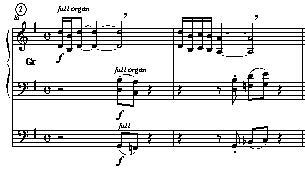
The second variation is more dramatic, with the first part of the hymn tune disguised but strongly influencing the melodic material. 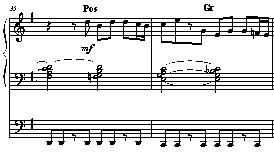
The verse portion of the tune is set in contrasting fashion: repeated bass notes, sustained left-hand chords, right hand playing with fragments of the tune. 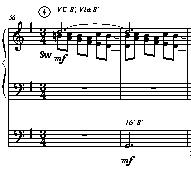
After a return to the beginning of the variation, the piece moves with a very slight break into variation 3. 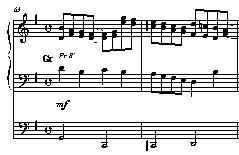
It has its own intro, which returns between phrases of the tune (ok--it's a ritornello). 
I had an 8' Principal in mind for the left-hand melody of variation 3. It works beautifully in Vaughan Williams' Rhosymedre. I wanted the same effect here.The right-hand material reappears in the following variation, as the hands switch material.
Variation 4 is the loudest, following directly on the heels of the previous variation, almost as thought it's the second half of a variation rather than a variation in its own right. Unlike previous variations, this one doesn't return to the refrain, but heads right into variation 5 (this is part of my feeling it as a second half rather than a separate variation). 
This final variation is softer: sustain notes or slow-moving lines in the left hand; repeated 16ths in the right hand; melody in the pedal on a 4' stop. I also added the zimbelstern, since I had one on the instrument for which I wrote the piece (I may work out a handbell choir part at my new position). The piece returns to a quiet, reflective mood and prepares the congregation (those who are listening!) for worship.
Tuesday, July 26, 2005
Goodbye and Hello/Reflected Joy mp3s
Following up on a comment DanW made to my last post, I'm going to repost the score excerpts of Reflected Joy 2, accompanied by links to mp3s. Hey! Given that my blog is pretty new, and the only people who have commented are my daughter and son-in-law (thanks y'all; check's in the mail...), I'm darn well going to listen to 50% of my audience! (OK--others have been by, but they've not left much of a footprint...) Here's the second excerpt:
First excerpt 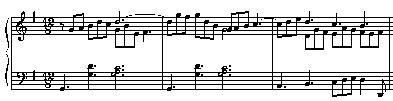 and accompanying mp3. I'm not pleased with the sound quality of the mp3s: a wav file was made directly from my Finale score (so the performance is not very musical, IMHO), loaded into Audacity (a very nice sound editor for the money...i.e. free). After a little processing (normalizing, adding a little room presence) clips corresponding to the score excerpts were saved. I think the files are too big. It'll be interesting to see how they download and play. Comments, anyone?
 and its mp3. For something a little different, listen to the whole piece in mp3 (a little over 2 minutes).
Monday, July 25, 2005
Perplexed Joy
Like the previous Reflected Joy, this piece is based on themes from my son Jeremy's upcoming wedding to Amanda Riegle. The flavor of Jesu, Joy is quite evident, as you can see in the first excerpt. The Beethoven Ode to Joy presence is quite subtle at the beginning, with the first hints coming in the left hand 7 measures in. There's a much stronger statement towards the end of the piece in the treble clef--I know, I know: the right hand has a little juggling to do, but it IS playable! Although nobody would call this a neo-Baroque piece, it flows more gracefully than its companion work largely because of the 12/8 time signature and the three-measure open-ended phrases.
While I like the impressionistic flavor of one of the motives of the previous piece, as well as the dramatic shifts as now you see, now you don't see the Beethoven, the flowing character of this piece may be more appropriate for the ceremony. About halfway through there's an interesting juxtaposition of keys, as the piece moves from G major to E-flat to C to D in successive phrases. Originally I'd had the piece return to its starting key, but the V-I progression was out of character since none of the other key changes were modulations as much as voice leading.
What a delightful dilemma: do I play the first piece I finished, or this one, or write another? All while packing up boxes of music and books to move to my new position, finishing my Mom's estate, turning our "camping out" chez Dad into a more livable arrangement--and more. Life is wonderfully full.
Saturday, July 23, 2005
Turning part 2: Reflected Joy
So I noticed that the happy couple had picked Jesu, Joy of Man's Desiring and Ode to Joy for walking in and walking out music.
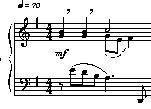 Even though I was writing an interlude sort of piece I wanted it to have some sort of liturgical connection by relating my piece to one of their choices. I developed three ideas--short motifs--and knitted them into the musical fabric (slightly too subtle reference to Marianne's knitting her "Mother of the Groom" dress). The first motive is based on the first three notes of Ode to Joy. There may be a reference to the running eighth notes of Jesu in the accompanying material, but that was unintentional. This motive is immediately varied
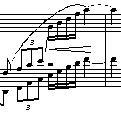 (up an octave, expanded, softer), setting the context for similar developments of the other motivic material that followed. A second, contrasting idea functions more as punctuation.
I wanted the piece to be improvisatory in feeling; people like music with a Romantic or Impressionist flavor; a nice arpeggio seemed to fill the bill. Did I mention the title? Reflected Joy seemed appropriate on a number of levels: the word "joy" in the music they chose; my piece being a reflection or meditation on their choices; the joy that we feel at their joy in each other.
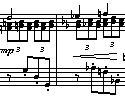 first idea; the thought of Impressionism made me think more chromatically and led to the development of the third motive, which gets a (to me) surprisingly large amount of play in the piece. It's developed the most, it leads to a couple climax points, and allows for some quite satisfactory expressive playing.
Did I mention how much fun I was having writing this piece? It occured to me at some point--about a minute into this two-minute piece--that I hadn't actually stated more than three or four notes of the theme (Ode to Joy) so I decided to refer more clearly to it, even though I was putting it in musical parentheses. It's softer than surrounding material, presented over a relatively static pattern, so that it's actually a break in the action, and not the main idea.
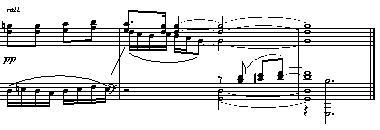
At some point all this joy has to end. Translation: I was getting tired and was ready to call it a night and get some sleep. In addition, the piece had reached the 2-minute mark; it was in danger of becoming a musical elephant in the liturgical china shop, so it was time to end, which I did with a final reference to the end of Ode to Joy as it's usually done in hymnals...with a slight contemporary flavor. (Note that the lower stave is initially in treble clef). I've made a MIDI file of the score which will give you an idea of the piece until I get around to making a recording.
Monday, July 18, 2005
Turning the Corner
I was wondering why I hadn't written more, and I realized that I'm still dealing with leaving a church position (I'm a church musician, if you're tuning in in mid-stream) earlier than I had planned with all of the unsettled feelings and unfinished business that goes with such an interruption. But as challenging as that all is, it represents a turning-point. Something new and exciting is coming.
I've interviewed for a new position. Even though the church is much smaller, the position fits me much better; it will be a good fit for everyone. I have a second interview shortly. It looks as though they're interested in me and I in them--I'm getting excited. So even though there's unfinished business and a sense of loss, at the same time there's renewed energy and a sense of growth.
So it's no wonder I haven't done much with Jeremy and Amanda's music. There hasn't been a lot of extra energy left for creativity. But the nice thing about turning corners is that your energy and creativity turn the corner too. And it's none too soon: the wedding is less than a month away! Let's see: what can I do with

Wednesday, July 13, 2005
Drawing a Blank, part 2
Jeremy and I talked about that tonight. It'll probably be no more than two minutes; played on piano. I asked about other service music: Jesu, Joy of Man's Desiring for the bride; Beethoven's Ode to Joy for the happy couple as they leave. Anyone for a little joy?
So I've started my precompositional planning. I need to decide on a style, develop a motivic idea or two (my wife Marianne suggested tossing in reference to a tune Jeremy sang when he was a kid--maybe...), and get some notes written. Not tonight, 'cause I'd like to get some sleep sometime and the last thing I need is to have the piece running through my brain. But it'll be working in the background anyway. Joy. Piano. Two minutes: barely enough time to get started; an eternity to complete. I'll let you know how it works out...
Saturday, July 09, 2005
Ready to Fly
I guess I don't get out often enough. Greg and Vickie from Calaveras are consumate artists, with strong singing and instrumental work. They sang "Ready to Fly" from their latest CD (visit CDBaby and search for "Calaveras"). The song spoke of one not getting ready to die but rather getting ready to fly. A wonderful image that was especially appropriate this morning.
The song has a folk/celtic sound with strong lyrics and strong music. I don't buy a lot of CDs--particularly by people I hear at memorial services--but I just bought two of theirs. It was nice to be jolted out of my comfortable musical rut. I'll probably have more to say after I've heard their CDs.
Thursday, July 07, 2005
All Things Bright and Beautiful...ptII
 After getting up real early (see ATBaB pt I), checking out some Point-of-Sale software we're thinking of installing in Marianne's yarn store, I headed off to the church where I'll be guest organist for a couple of weeks.
In addition to playing a voluntary by William Walond (a contemporary of G. F. Handel in London), I decided to play one of my organ variations on All Things... but found it difficult to pull one variation out of what is a pretty robust set of variations. I checked out my piano variation and really liked it (well, duh! I did write it.). To make it more challenging (for probably both performer and listener--but see my closing comment) I wrote it in 3/4, while the original (see the excerpt above) is in 4/4. Here's how the first statement of the melody looks in 3/4: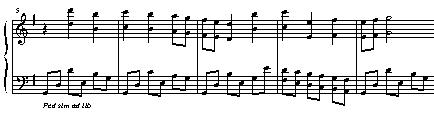
You may see hints of the melody in the tenor portion of the left hand, here doubling (the first two measures) and then following (the descending scale in the left hand in measure 4 imitating the descending scale in the right in measures 2 and 3). When the melody repeats, it comes in on beat 1, increasing the subtle canon...or so I hope!
The b or verse section handles the tension between 4 and 3 differently. In the original, the melody does this: This melody is a miniature masterpiece. As the verse continues, the melody rises to meet the beginning refrain. It's a neat way to make the refrain in this simple two-part form seam both fresh and inevitable.
I didn't want to do the same 3-against-4 procedure of the first part of my setting, so I fit the melody into its tighter quarters by eliminating repeated notes and shortening long notes: I stressed the lowness of the melody by moving it into the bass clef, and almost turned it into a sequential passage. Apart from just plain liking the tune, I have found that giving myself a musical challenge, like fitting 4 beats into 3, is compositionally stimulating--particularly since I want the result to be comfortable to the listener's ear. For all of my academic focus (rather ingrained after 25 years as a university music professor), this is no music for music's sake. I want to freshen people's ears while they hear something they know, even if they don't recognize it right away.
All Things Bright and Beautiful...pt I
...silence...
Monday, July 04, 2005
What tangled webs we weave...
I set things up so that the website mirrors my web directory on my computer. The uploading is automatic, which I find to be quite slick. As long as I don't goof and save over something I didn't intend to lose, it'll be great. (The answer, of course, is to back everything up.) Dreamweaver gives me a combination of "what you see" and handcoding that I find quite helpful. It's actually akin to my notation software (I use Finale, but Sibelius and others work much the same way). In the case of the notation software, I can look at the notes, or listen to MIDI playback, jsut as with DW I can look at the file, or see the behind-the-scenes code.
I'm intending to use my website as an every-growing catalog. While it's relatively static, I'm hoping to apply the sort of approach I took with my earlier post here about Ellacombe, where I provide program notes and a little background info along with excerpts from the music. I hope I haven't set me too much of a task. To see what I'm trying, check out my pages on a variation set for flute and piano (see discussion and excerpts). Since I'm hoping to provide enough information so that some performers might decide my stuff is worth working on, I'm trying to give them enough information to make an informed decision.
I attended a very nice organ recital at St. Mary's Cathedral in San Francisco on Sunday (July 3, 2005). Ansgar Wallenhorst, a German organist, held forth at the might Ruffatti. I'll have a couple of comments on this delightful event soon.