Choosing the music for a concert is at best a somewhat mysterious process (please see my earlier post for concert details). At the end, we hope that the audience will feel that the music fits together, that there is a flow and a connection among the pieces that makes the progression of pieces almost inevitable.
In the case of this program, we began with the Pinkham Christmas Cantata. It’s a great combination of challenging and moving moments for both audience and singers, and gave us the opportunity to design a program where brass played an important part—a treat for the Lyric Chorus, best known for its partnership with the fine pipe organ at San Francisco’s venerable Trinity Episcopal Church.
The Pinkham was designed to be sung with two brass choirs, or one brass group and organ (the version we’re doing). As we thought of what to program with it, Gabrieli’s In Ecclesiis came to mind. Just as the Pinkham is a 20th century tour de force, the Gabrieli occupies much the same position in the early 17th century. It’s actually written for a slightly larger band of instruments, but was pretty easy to arrange for our current instruments.
Since we were doing In Ecclesiis, why not include another Gabrieli, or some other multi-choir music? In short order we had added Gabrieli’s Hodie Christus natus est and Schütz’s Jauchzet dem Herren. Even though it doesn’t use brass, pairing a Schütz setting of Hodie made good sense, giving us both the opportunity to hear the text from a different vantage point as well as simply enjoy more than one work by this marvelous composer.
But wait: there’s still more music with brass! The Dufay Gloria ad modum tubae, the earliest work on our program, uses both choral and instrumental forces very sparingly, serving as a bridge from earlier chant and monophonic pieces to the later polyphonic works of the Renaissance. Because of its simplicity and directness, this work seemed like a great way to begin the concert. The Schütz Hodie, mentioned earlier, followed easily, even though the two works were separated by a couple hundred years, with the one work leading into the splendor of Renaissance polyphony, and the other a simplification of the complexity that often resulted from that polyphony.
As long as we were using brass, it made sense to have at least one work that featured our fine instrumentalists: one of Gabrieli’s Canzone per Sonare, a song without words. Although it fits chronologically between Dufay and Schütz, it follows these two in our program as it moves from the simple to multi-voice and multi-choir pieces.
After the multi-choir pieces by Gabrieli and Schütz mentioned earlier, we wanted a change of pace, both for contrast of textures and, quite frankly, to give our instrumentalists a break. Since our concert is in December, most of our music has either a Christmas or holiday theme. With that in mind, I couldn’t resist Joaquin Nin-Culmell’s delightful La virgin lava pañales. I studied composition with Don Joaquin, and came to appreciate his blend of the contemporary with the traditional. Our set of Hispanic pieces grew from that beginning, with the Vasquez En la fuente del rosel coming from a set of early Spanish choral music that Nin-Culmell edited and the González Serenissima una nocheshowing that the distance between classical and folk traditions is not very great. There is also an element of anticipation in this set, as we look towards our spring concert, Voices of Immigration¸ built around family and individual stories of our chorus members.
We wanted to end the concert with audience participation, and decided to bring back the Christmas Fantasy we premiered in 2009 (the composer part of me was quite pleased, since others suggested that we repeat the work!). In earlier planning, the second half of the concert consisted of the Pinkham cantata and the fantasy. It became apparent that something more was needed (in the Lyric Chorus we’re always looking for just one more thing!). I decided to add the brass quartet to the organ accompaniment—I can’t wait to hear it. In addition, as I was looking for that one more thing, I came across Victoria’s O Magnum Mysterium Mass, very strongly modeled on his moving O Magnum Mysterium, and our concert was complete.
There are layers of connections among the pieces on this program. The predominant language is Latin, and yet as early as Schütz we have a work in the vernacular (German, in this case). Our first half ends in Spanish, yet a Spanish composer (Victoria) brings us back to Latin at the start of the second half. There is a bit of a chronological ordering, with the oldest piece first and the newest piece last, and yet the flow of musical texture and style was much more important to us than the work’s provenance.
As we move into our closing weeks of the season, with an increasing sense of urgency as we realize that rehearsal time grows ever shorter and our list of spots still not fully learned grows every longer, we nonetheless revel in the richness and variety of the music, and look forward to sharing our passion for this music with our audience.
Monday, November 15, 2010


Thursday, November 11, 2010
Christmas Fantasy
From time to time I like to comment on one of my compositions. The process gives me the opportunity to take a step back and look at the piece, and also helps me create program notes. Since the Christmas Fantasy is on the San Francisco Lyric Chorus's upcoming concerts (December 4 and 5, 2010), this post is particularly timely.
Christmas Fantasy grew out of the process of developing the Lyric Chorus’s December 2009 program. We based our program on a list of 50 carols presented in the BBC Music Magazine. I wanted to be able to include some of the familiar carols on the list, but wished to do more with them than just sing a couple of verses and move on to the next carol--and wanted the audience to have the chance to sing. I had also been looking for a piece to end the concert, but none of the ones on the list was satisfactory. The answer was pretty obvious to me: write a piece that fulfilled these criteria.
First, a little background. To create the list, the BBC Music Magazine polled 50 choral conductors (primarily British, but including a few people across the pond…) for the five carols they most liked to include in their annual service of lessons and carols. From the 250 entries, the magazine picked the 50 most popular. As a result, in the case of some carols, like It Came Upon The Midnight Clear, tunes were picked that were more familiar to the British audience than to its American counterpart. My set begins with one of these less familiar tunes: Arthur Sullivan's Noel. I deliberately took some time introducing this tune, so that the audience could hear it develop. As it is presented, hints (both choral and instrumental) of Richard Willis' more familiar Carol (to American audiences, at least) appear.
The 2010 version of the Fantasy has an additional element: a brass quartet. Since our concert features music for chorus and brass, it only seemed appropriate to add the quartet to my piece. The challenge: add in the instruments in such a way that it sounds like the piece couldn’t exist without them, while at the same time NOT re-writing the choral or organ parts. In some instances, particularly when the audience sings, the brass doubles the choral harmony. In other spots, particularly those where I had the room to be more creative, the brass adds its own unique flavor.

In the example, the bottom staff shows the organ part, which is the full accompaniment in the original version. I kept the organ part spare, since I fully expected that the organist would sometimes also be the director; there are spots where I wanted a hand free to give cues and set the timing. In the 2010 version, the brass fills out the organ part, adding a fanfare to the organ pedal in the first section of the piece, while at the same time giving the sopranos their opening note as well as a hint of the melody. As the section continues, the brass fanfares build on each pedal tone, providing a bridge between organ and choir.
A short organ interlude introduces the second carol, O Come, All Ye Faithful. The audience sings along with the full ensemble on verse one. The men of the chorus sing verse two while the sopranos and altos offer a descant, hinting at yet another carol (Gloria).
The third carol, The First Nowell, begins with a canonic duet between solo soprano and tenor and ends with, well, a somewhat fanciful restatement of the refrain. This is followed immediately by a verse for audience and chorus. Following this verse, my refrain returns, leading into Silent Night. A group of soloists sings verse one, as singers move into place around the audience so that all may join together on verses two and three.

An instrumental interlude, based on Silent Night and Gloria, the tune that earlier appeared with O Come, All Ye Faithful, leads to the closing coda, with all four carols making an appearance. Ths section was perhaps the most fun to write, since Silent Night and The First Nowell are in 3, while the other carols are in 4 (note that Silent Night is presented in augmentation, while Nowell requires the singers to think in 3, while all around them the piece is in 4). It has been equally satisfying to write this piece and to work on it with the Lyric Chorus. I hope to post an excerpt, if not the full piece after our concert. If you're in the area, come to the concert!
As a composer, it is always my hope that what I write is music to more than just my ears...
Christmas Fantasy grew out of the process of developing the Lyric Chorus’s December 2009 program. We based our program on a list of 50 carols presented in the BBC Music Magazine. I wanted to be able to include some of the familiar carols on the list, but wished to do more with them than just sing a couple of verses and move on to the next carol--and wanted the audience to have the chance to sing. I had also been looking for a piece to end the concert, but none of the ones on the list was satisfactory. The answer was pretty obvious to me: write a piece that fulfilled these criteria.
First, a little background. To create the list, the BBC Music Magazine polled 50 choral conductors (primarily British, but including a few people across the pond…) for the five carols they most liked to include in their annual service of lessons and carols. From the 250 entries, the magazine picked the 50 most popular. As a result, in the case of some carols, like It Came Upon The Midnight Clear, tunes were picked that were more familiar to the British audience than to its American counterpart. My set begins with one of these less familiar tunes: Arthur Sullivan's Noel. I deliberately took some time introducing this tune, so that the audience could hear it develop. As it is presented, hints (both choral and instrumental) of Richard Willis' more familiar Carol (to American audiences, at least) appear.
The 2010 version of the Fantasy has an additional element: a brass quartet. Since our concert features music for chorus and brass, it only seemed appropriate to add the quartet to my piece. The challenge: add in the instruments in such a way that it sounds like the piece couldn’t exist without them, while at the same time NOT re-writing the choral or organ parts. In some instances, particularly when the audience sings, the brass doubles the choral harmony. In other spots, particularly those where I had the room to be more creative, the brass adds its own unique flavor.

In the example, the bottom staff shows the organ part, which is the full accompaniment in the original version. I kept the organ part spare, since I fully expected that the organist would sometimes also be the director; there are spots where I wanted a hand free to give cues and set the timing. In the 2010 version, the brass fills out the organ part, adding a fanfare to the organ pedal in the first section of the piece, while at the same time giving the sopranos their opening note as well as a hint of the melody. As the section continues, the brass fanfares build on each pedal tone, providing a bridge between organ and choir.
A short organ interlude introduces the second carol, O Come, All Ye Faithful. The audience sings along with the full ensemble on verse one. The men of the chorus sing verse two while the sopranos and altos offer a descant, hinting at yet another carol (Gloria).
The third carol, The First Nowell, begins with a canonic duet between solo soprano and tenor and ends with, well, a somewhat fanciful restatement of the refrain. This is followed immediately by a verse for audience and chorus. Following this verse, my refrain returns, leading into Silent Night. A group of soloists sings verse one, as singers move into place around the audience so that all may join together on verses two and three.

An instrumental interlude, based on Silent Night and Gloria, the tune that earlier appeared with O Come, All Ye Faithful, leads to the closing coda, with all four carols making an appearance. Ths section was perhaps the most fun to write, since Silent Night and The First Nowell are in 3, while the other carols are in 4 (note that Silent Night is presented in augmentation, while Nowell requires the singers to think in 3, while all around them the piece is in 4). It has been equally satisfying to write this piece and to work on it with the Lyric Chorus. I hope to post an excerpt, if not the full piece after our concert. If you're in the area, come to the concert!
As a composer, it is always my hope that what I write is music to more than just my ears...
Saturday, November 06, 2010
Britten Jubilate Deo
The choir at St. Stephen's Episcopal Church in Orinda CA is singing Benjamin Britten's delightful Jubilate Deo on Sunday, November 7, 2010. I included the date because Sunday is only a couple of hours away, and anyone reading this will likely be reading after the event.
Benjamin Britten (1913-1976) wrote this piece in 1961. It's one of a number of works he wrote for chorus and organ, the best of which, imho, is Rejoice in the Lamb, written almost 20 years earlier. The organ part in the Jubilate has the same sparkle as Rejoice. It's a challenge for a church choir, but one my choir has relished. Britten has given this short work a bit of a rondo feel, with a spirited opening section featuring antiphonal writing between unison (well, in octaves) ST and AB giving way to a thoughtful, chant-like section, succeeded by a return to the up-tempo feel of the beginning, followed in succession by another chant-like section and a closing rousing Amen.
I found out that he wrote this work as a companion to an earlier Te Deum in C written in 1934. This latter work is apparently 9 minutes long. Since the Jubilate is much shorter (a bit over 2 minutes) it doesn't balance well. That may be why he also wrote a Venite exultemus Domino in 1961, this latter work not published until after his death. After seeing a page of the Venite, I'm thinking seriously about giving it a go. It wouldn't surprise me if Britten had a couple of other canticles in mind, perhaps getting distracted by the War Requiem, which I believe was finished the following year.
As part of my research I visited the Britten-Pears Foundation website. Much more than I could absorb in a single visit. One of their projects is a complete online catalog of Britten's music: definitely worth an extended visit. I also came across an exhaustive discography of Britten's works.
Benjamin Britten (1913-1976) wrote this piece in 1961. It's one of a number of works he wrote for chorus and organ, the best of which, imho, is Rejoice in the Lamb, written almost 20 years earlier. The organ part in the Jubilate has the same sparkle as Rejoice. It's a challenge for a church choir, but one my choir has relished. Britten has given this short work a bit of a rondo feel, with a spirited opening section featuring antiphonal writing between unison (well, in octaves) ST and AB giving way to a thoughtful, chant-like section, succeeded by a return to the up-tempo feel of the beginning, followed in succession by another chant-like section and a closing rousing Amen.
I found out that he wrote this work as a companion to an earlier Te Deum in C written in 1934. This latter work is apparently 9 minutes long. Since the Jubilate is much shorter (a bit over 2 minutes) it doesn't balance well. That may be why he also wrote a Venite exultemus Domino in 1961, this latter work not published until after his death. After seeing a page of the Venite, I'm thinking seriously about giving it a go. It wouldn't surprise me if Britten had a couple of other canticles in mind, perhaps getting distracted by the War Requiem, which I believe was finished the following year.
As part of my research I visited the Britten-Pears Foundation website. Much more than I could absorb in a single visit. One of their projects is a complete online catalog of Britten's music: definitely worth an extended visit. I also came across an exhaustive discography of Britten's works.
Wednesday, November 03, 2010
But wait, there's more

The same weekend as the St. Stephen's Messiah Sing, the San Francisco Lyric Chorus offers its fall concert. Talk about a full weekend! Handel on Friday; Gabrieli, Schutz, Pinkham and others on Saturday (7:30 pm at Mission Dolores, San Francisco) and Sunday (3 pm at St. Stephen's Episcopal Church, Orinda). It's going to be an outstanding program, with music for chorus, brass quartet, and organ.It's always a juggling act, much like preparing a fine meal, getting everything ready for public consumption at the same time. The Lyric Chorus is well on track to do just that. The program includes works from the Renaissance through the piece that I wrote for the group, just premiered last December (a fun setting of four carols with audience participation).
In addition to works with brass and organ, we're doing an a capella set of Hispanic works as well as selections from Victoria's mass based on his hauntingly beautiful O Magnum Mysterium. What's particularly neat about the mass is that each movement is at the same time a variation of the theme while being true to the liturgical function the piece embodies. Someone who knew the O Magnum would recognize the connection of the mass with the theme even if the listener did not know the title of the mass.. Be sure to check out the SFLC website for more information.
* Guillaume Dufay Gloria Ad Modem Tubae
* Heinrich Schütz Hodie Christus Natus Est (SWV 315)
* Giovanni Gabrieli Canzona per Sonare, #4
* Giovanni Gabrieli Hodie Christus Natus Est
* Heinrich Schütz Jauchzet dem Herren
* Giovanni Gabrieli In Ecclesiis
* Juan Vasquez En la Fuente del Rosel
* Joaquin Nin-Culmell La Virgen Lava Pañales
* Fray Gerónimo González Serenissima Una Noche
* Tomás Luis de Victoria O Magnum Mysterium
* Tomás Luis de Victoria O Magnum Mysterium Mass selections
* Daniel Pinkham Christmas Cantata
* Robert Train Adams Christmas Fantasy
Messiah Sing
The end of the year is always a busy time for any musician. In addition to my usual compositional stuff, I have three concerts coming up in the next month and a half, the first being the 16th annual Messiah Sing at St Stephen's Episcopal Church in Orinda, CA. It's a fun event, with usually about 250 in attendance. We sing the Christmas portion with a chamber orchestra, soloists and choir of 40 or so to support the usually quite vocal audience.
The church choir sang Glory to God this past Sunday. Even though I've conducted portions of Messiah for the last 56 years, I'm always finding something new. This past Sunday was no exception. At a Sing, everyone tends to charge right ahead, ignoring any semblance of dynamics or musical form. My choir, on the other hand, thrives when we pay attention to "details" like dynamics, articulation and even the meaning of the text.
While we're working with the Schirmer score--not my favorite, but the one the choir is used to--the dynamics give a nice sense of buildup, starting mezzo (sops find mp on the high f# a bit of a challenge) and gradually building to the triumphant restating of "good will" on the last page. It was such fun, that I can't wait for our more extended performance on December 3. Now if I didn't still have a full list of non-musical details to attend to, I would just revel in the music. But attention to detail is one of the important elements of a successful performance, so it's back to recruiting that final instrumentalist, getting parts out to the performers, checking the stand lights, and working with a wonderful music committee, while reviewing the score and preparing the choir--what a great time to be a musician!
The church choir sang Glory to God this past Sunday. Even though I've conducted portions of Messiah for the last 56 years, I'm always finding something new. This past Sunday was no exception. At a Sing, everyone tends to charge right ahead, ignoring any semblance of dynamics or musical form. My choir, on the other hand, thrives when we pay attention to "details" like dynamics, articulation and even the meaning of the text.
While we're working with the Schirmer score--not my favorite, but the one the choir is used to--the dynamics give a nice sense of buildup, starting mezzo (sops find mp on the high f# a bit of a challenge) and gradually building to the triumphant restating of "good will" on the last page. It was such fun, that I can't wait for our more extended performance on December 3. Now if I didn't still have a full list of non-musical details to attend to, I would just revel in the music. But attention to detail is one of the important elements of a successful performance, so it's back to recruiting that final instrumentalist, getting parts out to the performers, checking the stand lights, and working with a wonderful music committee, while reviewing the score and preparing the choir--what a great time to be a musician!
Saturday, June 06, 2009
tempo rubato
It's been a good week musically. Last Sunday was Pentecost; the choir sang well, with a very spirited rendition of William Dawson's Ev'ry Time I Feel the Spirit. Monday the choir was one of two at the San Francisco AGO's post-annual meeting concert. They were fabulous. In addition to performing works of several others, the performed my My Heart is not Lifted Up from The Needham Psalter, written in 1990. Marianne (my wife) sang the solo quite nicely, and the choir was right into the piece with her. When I get a chance I'll add in a clip from the piece.
But there was more. I performed And they were filled with the Holy Spirit, a work for solo organ, which I wrote in 1985. The Petty-Madden organ at First Congregational Church of Berkeley was in fine form. The audience--primarily organist colleagues--was quite complementary. I was delighted to be invited to perform the work again this week at the Composers' Forum put on by the Peninsula Chapter of the AGO (which I did this afternoon). It was fun on both these occasions to hear what fellow composers were writing--and even more fun to be able to share my work.
I'm hoping that this will get me working on promoting my music a bit more, and returning to the publication fray. This was a nice break from all the emotional fallout and ensuing work resulting from my father's passing almost a month ago.
More on that later. In the meantime, the forum, the concert, and the church service were music to my ears.
But there was more. I performed And they were filled with the Holy Spirit, a work for solo organ, which I wrote in 1985. The Petty-Madden organ at First Congregational Church of Berkeley was in fine form. The audience--primarily organist colleagues--was quite complementary. I was delighted to be invited to perform the work again this week at the Composers' Forum put on by the Peninsula Chapter of the AGO (which I did this afternoon). It was fun on both these occasions to hear what fellow composers were writing--and even more fun to be able to share my work.
I'm hoping that this will get me working on promoting my music a bit more, and returning to the publication fray. This was a nice break from all the emotional fallout and ensuing work resulting from my father's passing almost a month ago.
More on that later. In the meantime, the forum, the concert, and the church service were music to my ears.
Wednesday, March 19, 2008
rubato to the max
So I've been away a while. Actually, I've been ignoring my blog, my webpage, and have generally been preoccupied with real as opposed to virtual life. I'm hoping that I might be back (I'll know if I keep these entries going for a few weeks..).
Things have changed. I'm no longer the Music Director at John Knox Presbyterian Church in Dublin CA (a great group of people), but have been Minister of Music at St. Stephen's Episcopl Church in Orinda CA since mid-November 2007. It's been an exciting change, with different and increased responsibilities--about which I'll have more to say on another post.
The San Francisco Lyric Chorus keeps challenging me, with concerts upcoming in another month. They are singing the west coast premiere of my It Will Be Summer--Eventually, a setting of poems of Emily Dickinson approaching its 20th anniversary.
I'm taking handbell lessons with Michele Sharik, with the intent of developing some ability to play solo handbell music (actually, I'd just like to know the instrument better, and I learn better when I have a goal).
I'll add more soon--probably after Holy Week services, which pick up a full head of steam tomorrow (Thursday, and keep on coming until Sunday noon.
And that's music to my ears.
Things have changed. I'm no longer the Music Director at John Knox Presbyterian Church in Dublin CA (a great group of people), but have been Minister of Music at St. Stephen's Episcopl Church in Orinda CA since mid-November 2007. It's been an exciting change, with different and increased responsibilities--about which I'll have more to say on another post.
The San Francisco Lyric Chorus keeps challenging me, with concerts upcoming in another month. They are singing the west coast premiere of my It Will Be Summer--Eventually, a setting of poems of Emily Dickinson approaching its 20th anniversary.
I'm taking handbell lessons with Michele Sharik, with the intent of developing some ability to play solo handbell music (actually, I'd just like to know the instrument better, and I learn better when I have a goal).
I'll add more soon--probably after Holy Week services, which pick up a full head of steam tomorrow (Thursday, and keep on coming until Sunday noon.
And that's music to my ears.
Tuesday, July 31, 2007
dolce, ma con moto
Summer is supposed to be a little more relaxed. Back in the day when I relied quite a bit on freelance income from my musical pursuits, it was. And with all that extra time to do things, I didn't have the disposable income to do them!
I'm not doing as much freelance these days, but I find I'm actually busier. This past weekend, I played at two different churches, neither one where I normally serve. On Saturday I played keyboard for St. Bridget's Church, an Episcopal start-up in Rio Vista (roughly halfway between the San Francisco Bay Area and Sacramento). It was a small but valiant congregation (less than 20 in attendance). They hold one weekend service a month, in between having weekday services, small groups, social and outreach activities. A fun group to visit.
I also played at St. Paul's Episcopal Church in Walnut Creek, where I learned to play organ and played my first services as a young musician. It was satisfying for different reasons than Rio Vista. St. Paul's is quite established, although they, too, are trying to grow (a congregation of over 200). I played a Harrison & Harrison tracker in the chapel (it replaced the reed organ I played as a teenager), and a good-sized two manual Schlicker in the main church.
Whether new or established, both churches are dealing with issues of identity, building on Episcopal tradition while looking towards the future. Meanwhile, at John Knox Presbyterian in Dublin CA (where I serve as Director of Music), the children and adults who participated in last week's Vacation Bible School led the service.
JKPC, roughly the same size as St. Paul's, is also dealing with the same issues of identity and growth. Where St. Paul's has a strong traditional service, JKPC blends contemporary and traditional elements, both in service structure and in its music: Praise Band and Chancel Choir usually share the chancel, with children's groups and adult handbells regularly enriching the mix.
I got onto this because my quiet summer hasn't been quiet, but rather filled with variety and offer opportunities for growth. In my previous post, I mentioned Amy Beach's Mass in E-flat, which we perform in less than a month. That has offered the San Francisco Lyric Chorus some of the same opportunities for reflection on identity and growth as the churches I mentioned above. And then our daughter Delara and her husband are moving from London to L.A.; and our son Jeremy and his spouse are moving from Massachusetts to Pennsylvania.
So maybe there's a time for growth.
That is definitely music to my ears...
I'm not doing as much freelance these days, but I find I'm actually busier. This past weekend, I played at two different churches, neither one where I normally serve. On Saturday I played keyboard for St. Bridget's Church, an Episcopal start-up in Rio Vista (roughly halfway between the San Francisco Bay Area and Sacramento). It was a small but valiant congregation (less than 20 in attendance). They hold one weekend service a month, in between having weekday services, small groups, social and outreach activities. A fun group to visit.
I also played at St. Paul's Episcopal Church in Walnut Creek, where I learned to play organ and played my first services as a young musician. It was satisfying for different reasons than Rio Vista. St. Paul's is quite established, although they, too, are trying to grow (a congregation of over 200). I played a Harrison & Harrison tracker in the chapel (it replaced the reed organ I played as a teenager), and a good-sized two manual Schlicker in the main church.
Whether new or established, both churches are dealing with issues of identity, building on Episcopal tradition while looking towards the future. Meanwhile, at John Knox Presbyterian in Dublin CA (where I serve as Director of Music), the children and adults who participated in last week's Vacation Bible School led the service.
JKPC, roughly the same size as St. Paul's, is also dealing with the same issues of identity and growth. Where St. Paul's has a strong traditional service, JKPC blends contemporary and traditional elements, both in service structure and in its music: Praise Band and Chancel Choir usually share the chancel, with children's groups and adult handbells regularly enriching the mix.
I got onto this because my quiet summer hasn't been quiet, but rather filled with variety and offer opportunities for growth. In my previous post, I mentioned Amy Beach's Mass in E-flat, which we perform in less than a month. That has offered the San Francisco Lyric Chorus some of the same opportunities for reflection on identity and growth as the churches I mentioned above. And then our daughter Delara and her husband are moving from London to L.A.; and our son Jeremy and his spouse are moving from Massachusetts to Pennsylvania.
So maybe there's a time for growth.
That is definitely music to my ears...
Tuesday, June 05, 2007
PPP
I don't know where the time went! I've written and performed some new pieces, continued directing the handbell choir at church (not to mention the Chancel Choir and our contemporary ensemble), become assistant director of San Francisco Lyric Chorus, and otherwise filled up time in a number of interesting ways...but not said anything here since December.
Oh, yeah: And it's past time to celebrate the publication of I Come with Joy, a collection of my liturgical piano pieces published in March 2007 by Augsburg Fortress. I'm quite pleased by the set.
In succeeding entries I want to look at some of my compositions, including the piano pieces, comment on a blog or two I've been enjoying lately, and look at a couple of pieces I'm going to be playing soon: Herbert Howells' Partita and Amy Beach's Grand Mass in E-flat. Right now, I'm off to practice (26 days left before the Howells goes public...).
For now, that's music to my ears.
Oh, yeah: And it's past time to celebrate the publication of I Come with Joy, a collection of my liturgical piano pieces published in March 2007 by Augsburg Fortress. I'm quite pleased by the set.
In succeeding entries I want to look at some of my compositions, including the piano pieces, comment on a blog or two I've been enjoying lately, and look at a couple of pieces I'm going to be playing soon: Herbert Howells' Partita and Amy Beach's Grand Mass in E-flat. Right now, I'm off to practice (26 days left before the Howells goes public...).
For now, that's music to my ears.
Friday, December 22, 2006
poco a poco
Little by little things get done. Another day and the formerly-hidden oak floors return to their original glory. As soon as workers return from a (well-deserved for some) holiday break, we'll be able to live in more than one bedroom and the kitchen, with an occasional sojourn in a semi-working bathroom...
On the musical front, it's a combination of getting ready for Christmas Eve services (one morning, 3 evening) and posting a bunch of my compositions on New Music Jukebox (run by American Music Center). I've had some modest success selling my music; it's time to promote better.
poco a poco: a little bit each day. But my fingers are getting itchy to write--the last composition of 2006? the first of 2007? Before I can do that, I need to burn a CD with my Christmas Eve postlude (so I can be in two places at once...).
Whether fast or slow (and moving slowly, even poco a poco on the way from one dynamic state to another, is not my natural state), it's music to my ears.
On the musical front, it's a combination of getting ready for Christmas Eve services (one morning, 3 evening) and posting a bunch of my compositions on New Music Jukebox (run by American Music Center). I've had some modest success selling my music; it's time to promote better.
poco a poco: a little bit each day. But my fingers are getting itchy to write--the last composition of 2006? the first of 2007? Before I can do that, I need to burn a CD with my Christmas Eve postlude (so I can be in two places at once...).
Whether fast or slow (and moving slowly, even poco a poco on the way from one dynamic state to another, is not my natural state), it's music to my ears.
Tuesday, December 19, 2006
Pianissimo
Well, my life has been anything but quiet...but I've managed to take a five month break without even trying. In my last post (July 22) I spoke about putting together some info on Songs of Prophecy. I've done that, but just not taken the time to post it. Five months later, I'm in the afterglow of a pretty nice presentation of the piece two days ago.
The piece went well, and even exceeded my expectations. It was the first time I've written an extended work with handbells (the piece includes handbells, choir and string quartet), so it was, for me, a bit experimental. The handbell writing worked, although I tended to write the part a little thin. We ended up adding notes to fill out chords (handbells are more homophonic than linear, imho, although my linear parts fit nicely with the strings and voices).
We're in the middle of a big house remodel (we moved in with my Dad almost 2 years ago)--roof and windows done first (last summer, just about the time I stopped writing here). Currently we're in the midst of walls, floors, bathrooms--it'll be great when it's done (did I mention kitchen next?).
I'll post the info on Songs of Prophecy soon, as well as update on some of my other musical activities. I need to put some quality time into updating my my composition list on New Music Jukebox before the end of the year (they are putting together a compilation for an upcoming Chamber Music America conference--it'd be nice to have some of my recent chamber works included).
Even though I have to leave the house these days to hear it (unless I want to write an homage to Varese, or an update of The Anvil Chorus)--
it's music to my ears.
The piece went well, and even exceeded my expectations. It was the first time I've written an extended work with handbells (the piece includes handbells, choir and string quartet), so it was, for me, a bit experimental. The handbell writing worked, although I tended to write the part a little thin. We ended up adding notes to fill out chords (handbells are more homophonic than linear, imho, although my linear parts fit nicely with the strings and voices).
We're in the middle of a big house remodel (we moved in with my Dad almost 2 years ago)--roof and windows done first (last summer, just about the time I stopped writing here). Currently we're in the midst of walls, floors, bathrooms--it'll be great when it's done (did I mention kitchen next?).
I'll post the info on Songs of Prophecy soon, as well as update on some of my other musical activities. I need to put some quality time into updating my my composition list on New Music Jukebox before the end of the year (they are putting together a compilation for an upcoming Chamber Music America conference--it'd be nice to have some of my recent chamber works included).
Even though I have to leave the house these days to hear it (unless I want to write an homage to Varese, or an update of The Anvil Chorus)--
it's music to my ears.
Saturday, July 22, 2006
Dies Irae (trans. it's d**n hot!)
Did I say that it was hot today? As I write this at 9:45 in the evening, it is still 95 degrees F. outside. That's hot, even for this part of California, where a little heat in the summer is a worthwhile price to pay for generally quite temperate weather.
I'm working on several posts that I hope will come to completion over the next week.
There will be more. I read through parts of a couple of Mozart 4-hand Sonatas tonight: I hope our hosts for the evening don't have too much trouble cleaning up all the misused and abused notes we left lying around. Somewhere between Mozart and Adams...
it's music to my ears...
I'm working on several posts that I hope will come to completion over the next week.
- An index of my compositions that I have mentioned here. As part of that I hope to provide some missing but promised mp3s.
- A fuller description of Songs of Prophecy. I'm in the process of compiling pdfs and jpegs (but before I can, I need to proofread the score; that'll probably take as much time as the initial writing of the piece!).
- A comparison of my use of the text with Jennens' Messiah libretto. His work was masterful. My deconstruction and rearrangement is...I guess we'll wait and see.
There will be more. I read through parts of a couple of Mozart 4-hand Sonatas tonight: I hope our hosts for the evening don't have too much trouble cleaning up all the misused and abused notes we left lying around. Somewhere between Mozart and Adams...
it's music to my ears...
Tuesday, July 18, 2006
Songs of Prophecy
In my last post, andante down the lazy river I mentioned that I was starting a Christmas Cantata. It's basically done, and I'm rather pleased by the results. Of course, if I didn't like it, it wouldn't be done, or wouldn't see the light of day! The reason it took so long (5 days) was that I did have to eat and sleep...not to mention make some music at church, teach an organ lesson, and do those pesky chores that just mount up and make the environs miserable until you pay attention to them...
The piece is called Songs of Prophecy. It uses 8 of the texts that Jennens, the librettist of Handel's Messiah included in what we know as the Christmas portion. I've long wanted to make my own work on the whole set of Messiah texts, but wisely set a less lofty goal for this piece.
Jennens generally has a very nice recitative, song, chorus form that focuses and organizes things very well. I totally ignored that form, although roughly speaking solo or soli voice alternates with chorus--but no real recitative.
I know, you'd like examples, and I don't have time right now. OK, here's one score excerpt: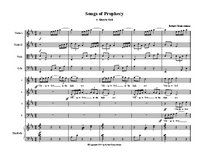
And it sounds roughly like this mp3 without any editing or real balancing of voices (the first violin is a bit shrill on my computer).
My intent was to write a piece we could use in worship, so I wanted it under 20 minutes (I'm at about 16 and a half). In addition to satb chorus, I wrote for string quartet and handbells. I was fascinated how that altered my usual textures. I tended to opt for repeated peals, open harmonies, and a good degree of pentatonic writing.
This was just plain fun to write. I couldn't wait to get up and start writing to see how the next movement was going to come out. It has its derivative elements: African choral music, minimalism, Orff, and I also hear Adams (this Adams, that is), particularly from my Needham Psalter. The combination of chorus, strings and handbells is wonderful.
I'll post more soon on this project. I'm preparing a table comparing the use of the texts in Handel's piece and mine; I'd like to say something about each movement and how I felt the text flowed from movement to movement. And so on. And, as you would expect:
It's music to my ears...
The piece is called Songs of Prophecy. It uses 8 of the texts that Jennens, the librettist of Handel's Messiah included in what we know as the Christmas portion. I've long wanted to make my own work on the whole set of Messiah texts, but wisely set a less lofty goal for this piece.
Jennens generally has a very nice recitative, song, chorus form that focuses and organizes things very well. I totally ignored that form, although roughly speaking solo or soli voice alternates with chorus--but no real recitative.
I know, you'd like examples, and I don't have time right now. OK, here's one score excerpt:

And it sounds roughly like this mp3 without any editing or real balancing of voices (the first violin is a bit shrill on my computer).
My intent was to write a piece we could use in worship, so I wanted it under 20 minutes (I'm at about 16 and a half). In addition to satb chorus, I wrote for string quartet and handbells. I was fascinated how that altered my usual textures. I tended to opt for repeated peals, open harmonies, and a good degree of pentatonic writing.
This was just plain fun to write. I couldn't wait to get up and start writing to see how the next movement was going to come out. It has its derivative elements: African choral music, minimalism, Orff, and I also hear Adams (this Adams, that is), particularly from my Needham Psalter. The combination of chorus, strings and handbells is wonderful.
I'll post more soon on this project. I'm preparing a table comparing the use of the texts in Handel's piece and mine; I'd like to say something about each movement and how I felt the text flowed from movement to movement. And so on. And, as you would expect:
It's music to my ears...
Thursday, July 13, 2006
andante down the lazy river
Well, it is summer. And it's been more weeks than I like since I posted. No good reason. Oh yeah--there were the various tasks and projects I mentioned in my last post. We refinanced Dad's house, moved his IRA, and will have new windows in the house in a couple of weeks. I've written some music (surprise!) and will be posting about a couple of new pieces soon.
I've also started a project I've been resisting, because it means focusing on something besides writing new music. With Jeremy's able assistance, I'm starting a major revision of my website. I'm working on a master list of all my compositions (well, those worth seeing the light of day!) with accompanying information pages, and score and audio excerpts. I've been resisting for months, but finally gave in. If you want to check out the work in progress, click here.
By the time I'm done, I hope to have all my scores and recordings on a couple of DVDs, as well as a pretty full website. I'm also going to make sure that full scores and information get posted on the American Music Center's New Music Jukebox.
The rest of the month should be full
A little golf, work around the Yarn Boutique, nagging Dad to get some exercise rather than just sitting around the house all day (and coincidentally reminding Marianne and me to do the same!), and other important family and friends things fill up my dance card.
Summertime in California (as long as the wildfires keep their distance) is delightful music to my ears...
I've also started a project I've been resisting, because it means focusing on something besides writing new music. With Jeremy's able assistance, I'm starting a major revision of my website. I'm working on a master list of all my compositions (well, those worth seeing the light of day!) with accompanying information pages, and score and audio excerpts. I've been resisting for months, but finally gave in. If you want to check out the work in progress, click here.
By the time I'm done, I hope to have all my scores and recordings on a couple of DVDs, as well as a pretty full website. I'm also going to make sure that full scores and information get posted on the American Music Center's New Music Jukebox.
The rest of the month should be full
- I'm starting a Christmas cantata for satb chorus, string quartet, and handbells.
- I've developed the concept for a children's musical for church. The book will need much work before I can actually put in music.
- I just set my current church's mission statement to music; it's upbeat and about as pop contemporary as I get these days. I look forward to putting it to work.
- Developed a second sequence on Nicea ("Holy, Holy, Holy"). It'll be the prelude this Sunday.
- On the non-musical front, there's a lot of cleanup, both at Dad's house and ours, particularly if we decide to move back to our place while the windows are put in
A little golf, work around the Yarn Boutique, nagging Dad to get some exercise rather than just sitting around the house all day (and coincidentally reminding Marianne and me to do the same!), and other important family and friends things fill up my dance card.
Summertime in California (as long as the wildfires keep their distance) is delightful music to my ears...
Monday, June 12, 2006
dal Segno
I've made some good progress this past week on the list I posted last week, and also had a couple of neat creative experiences. First, the list:
But there were also some nice creative moments this week...
I received a copy of the concert program that flautist Dawn Grapes and organist Joe McConathy presented in Fort Collins on April 30, 2006. They performed two of my works on Jesus Loves Me. The accompanying CD was quite nice. It was a fun program. If I can get permission, I'll post their performance of my pieces, either here or at New Music Jukebox (a site maintained by the American Music Center where I have a few works posted--I really need to make sure it duplicates my own site).
I composed my postlude for last Sunday: an electronic arrangement of Nicaea (better known as Holy, Holy, Holy, Lord God Almighty). I basically used a big band setup: lots of saxes, trumpets and trombones, with some guitar and piano assistance. Eventually I hope to have a CD's worth of pieces (this is number 2). You can hear it here. I'd intended to use a sequencer, but got started with Finale. I added more dynamics and articulation detail than I might have done for acoustic performers.
The main reason I composed Nicaea was so that I wouldn't have to play a postlude after the service, since, in addition to my usual musical duties, I was preaching the sermon. I had a wonderful time. I was somewhat nervous before getting to the podium, but calmed down as soon as the choir and I started presenting the old testament lesson. I've spent a good bit of time over the last two weeks on the sermon--not much different than the sort of time I spend on a new composition, where I am both writing and performing the work.
So it's been a good week. I hope to have another post in a few days. Until then, it's all
...music to my ears.
- Dad's finances: while it never ends, we are about to close on a loan which will allow us to fix up Dad's house
- Beginning stages of fixup work on Dad's house: windows are ordered; final preliminary plans for other needed work should be done this week
- 2005 ASCAPlus list: done and submitted (as prep for next year, I'm updating a sadly out-of-date "What's New" section of my website that really makes putting the list together much easier)
- Making an SATB version of a recent men's piece: rehearsals are going well; the piece is scheduled for the end of June
- Did I mention Dad's finances?
- Still looking into some additional sources of income: A couple of part- or short-term teaching slots I was looking into didn't pan out
- Dealt with an overbooking at the Kauai condo: a financial loss for us, but I think our guests will be pleased
- Have I brought up Dad's finances?
But there were also some nice creative moments this week...
I received a copy of the concert program that flautist Dawn Grapes and organist Joe McConathy presented in Fort Collins on April 30, 2006. They performed two of my works on Jesus Loves Me. The accompanying CD was quite nice. It was a fun program. If I can get permission, I'll post their performance of my pieces, either here or at New Music Jukebox (a site maintained by the American Music Center where I have a few works posted--I really need to make sure it duplicates my own site).
I composed my postlude for last Sunday: an electronic arrangement of Nicaea (better known as Holy, Holy, Holy, Lord God Almighty). I basically used a big band setup: lots of saxes, trumpets and trombones, with some guitar and piano assistance. Eventually I hope to have a CD's worth of pieces (this is number 2). You can hear it here. I'd intended to use a sequencer, but got started with Finale. I added more dynamics and articulation detail than I might have done for acoustic performers.
The main reason I composed Nicaea was so that I wouldn't have to play a postlude after the service, since, in addition to my usual musical duties, I was preaching the sermon. I had a wonderful time. I was somewhat nervous before getting to the podium, but calmed down as soon as the choir and I started presenting the old testament lesson. I've spent a good bit of time over the last two weeks on the sermon--not much different than the sort of time I spend on a new composition, where I am both writing and performing the work.
So it's been a good week. I hope to have another post in a few days. Until then, it's all
...music to my ears.
Friday, June 02, 2006
lento ma non troppo
Well, I've not exactly been setting the blogosphere on fire! Life seems to have been pretty full, although there always seems to be a list of things I still have to do. Main sources of time-passing (some more fruitful than others):
It seems like music is getting slighted. But I have some thoughts on a couple of upcoming projects...
Project 1
A couple of weeks ago the children presented a musical as part of worship (Sermon on the Mound). It was cute. The kids clearly enjoyed themselves, and had a number of strong moments. The adults who assisted and guided the project also did wonderfully. The song Out in Right Field, recorded by Peter, Paul and Mary, is featured--it's a great moment.
So I started thinking...is it time to write a musical for the kids myself? I'd have a good six months to work on it. I noticed some areas in this work that could be improved upon:
Project 2
I'm playing organ and/or piano for a wedding the first weekend in August (the organ isn't much). The bride is the daughter of a good friend of high school vintage. I may play more piano than organ, and so I'm thinking of writing a postlude. Probably along the lines of a trumpet voluntary, but for piano rather than organ. Could be a fun challenge.
...and I thought of a project that is still in progress that I'd like to say a few things about: a setting of Isaiah 6:1-8, originally written for chorus and organ, but arranged for chorus, organ and cello. I'm thinking of some comments on the process of transcribing for different resources--both in my music and in some interesting works for violin and organ I purchased recently.
As usual, it's music to my ears...
- Dad's finances
- Beginning stages of fixup work on Dad's house (roof, with walls, electrical, windows, plumbing and painting still to come)
- Getting my 2005 ASCAPlus list done and submitted
- Making an SATB version of a recent men's piece (I tried it with the choir last night; it looks to be very successful)
- Did I mention Dad's finances?
- Looking into some additional sources of income, including a couple of part- or short-term teaching slots (but either they're slow or I'm not in the running!)
- Dealing with an overbooking at the Kauai condo (communication is REAL important)
- Have I brought up Dad's finances?
It seems like music is getting slighted. But I have some thoughts on a couple of upcoming projects...
Project 1
A couple of weeks ago the children presented a musical as part of worship (Sermon on the Mound). It was cute. The kids clearly enjoyed themselves, and had a number of strong moments. The adults who assisted and guided the project also did wonderfully. The song Out in Right Field, recorded by Peter, Paul and Mary, is featured--it's a great moment.
So I started thinking...is it time to write a musical for the kids myself? I'd have a good six months to work on it. I noticed some areas in this work that could be improved upon:
- The vocal range is too great for kids (at least a 10th, I think). It should be kept within an octave, and not higher than c5 (an octave above middle c).
- Through-composed or complicated melodies should be minimized ("Right Field" worked--a great example of story-telling in song--but it was sung by an adult). While one doesn't want the piece reduced to a set of simple choruses, simplicity is important.
- There's an almost glib use of bible verses, reflecting the evangelical focus of the author and composer, I sure. Less would be more, I think.
Project 2
I'm playing organ and/or piano for a wedding the first weekend in August (the organ isn't much). The bride is the daughter of a good friend of high school vintage. I may play more piano than organ, and so I'm thinking of writing a postlude. Probably along the lines of a trumpet voluntary, but for piano rather than organ. Could be a fun challenge.
...and I thought of a project that is still in progress that I'd like to say a few things about: a setting of Isaiah 6:1-8, originally written for chorus and organ, but arranged for chorus, organ and cello. I'm thinking of some comments on the process of transcribing for different resources--both in my music and in some interesting works for violin and organ I purchased recently.
As usual, it's music to my ears...
Wednesday, April 26, 2006
Flutes rule!
...or maybe it's the flautists who rule. I'm starting to get a steady trickle of interest in my music at my website www.adamsworks.com: an occasional instrumentalist here, a conductor there, but more than any other category--flautists.
Actually, I've always found flautists to be interested in pushing the musical envelope. My high school sweetheart played flute: just spending time with me was already taking a risk! Much of my recent flute and keyboard music was written for her niece, just to keep things in the family.
One recent visitor, Sue Agnew, played (it was actually a premiere) my Variations on a French Carol" on Easter at St. Philip's Episcopal Church in Tucson, Arizona. Another, Dawn Grapes, will be playing Meditation on Jesus
Loves Me and Jesus Loves Me Variations as a set on a recital at First Presbyterian Church in Fort Collins on Sunday, April 30. I'm looking forward to that, even if in absentia.
It's nice to know that something that's music to my ears moves others--especially those intrepid flautists--to share that music with other ears.
On a non-musical note, Dad and I return to California later today. I'll comment more on the trip in an upcoming post. Let's just say that I have a more intimate understanding of how a toilet works...
Actually, I've always found flautists to be interested in pushing the musical envelope. My high school sweetheart played flute: just spending time with me was already taking a risk! Much of my recent flute and keyboard music was written for her niece, just to keep things in the family.
One recent visitor, Sue Agnew, played (it was actually a premiere) my Variations on a French Carol" on Easter at St. Philip's Episcopal Church in Tucson, Arizona. Another, Dawn Grapes, will be playing Meditation on Jesus
Loves Me and Jesus Loves Me Variations as a set on a recital at First Presbyterian Church in Fort Collins on Sunday, April 30. I'm looking forward to that, even if in absentia.
It's nice to know that something that's music to my ears moves others--especially those intrepid flautists--to share that music with other ears.
On a non-musical note, Dad and I return to California later today. I'll comment more on the trip in an upcoming post. Let's just say that I have a more intimate understanding of how a toilet works...
Monday, April 17, 2006
a tempo
Some of my small cadre of most excellent readers have wondered where I've been, even going to the extreme of emailing me. Thanks y'all. Things have been busy, and I got out of the habit of posting. I've missed it, even as I've been busy accompanying a singer in a competition (she was delighted with her second place finish, as was I), preparing for Easter (more on that below), making music in one form or other, including writing several pieces, and in general feeling that life was fairly full.
Today my Dad and I flew to Kauai for 9 days work on his condo in Poipu (well, um, I do plan on a couple bouts of serious golf). It is nice to get away, even as I feel that I'm leaving things on hold (including Marianne's looong day trying to make sense out of our taxes; it was very unlike her to not remain for the party at the post office when she mailed our stuff this evening--clearly she was tired--and I was thankful for her hard work--she'll undoubtedly have more to say to me on that matter...).
Easter was very nice. John Knox Pres in Dublin held two services rather than its normal one. Both well attended. I had decided a couple of months ago to have us present Don Francisco's He's Alive (listen to the composer's rendition here. Marianne and I had seen Dolly Parton perform the piece on Leno a number of years ago, and we had performed it ourselves several times. I thought it would be a great piece to combine our 30-voice choir with our Praise Team (10+ singers, several guitars, bass, drums, keyboard) and a brass quartet we put together for Easter.
It took longer than I had hoped (part of the reason for my no-show here). The final score only came together less than a week before we presented the piece. Along the way, I got the idea of combining O Sacred Head, Sore Wounded with He's alive. A couple of excerpts punctuate the first half of the piece, while the opening melody backs up the singer at a couple of strategic points. A quartet from the praise team also sings backup, while both singing ensembles provide a wonderful antiphonal effect at the final He's Alive chorus.
I'd already started working on the piece, when it finally appeared on the rader screen of our pastor (a wonderful person with decent musical chops...plus he sings tenor!!!). We first thought it might function as scripture in song, but he had the brainstorm of combining it with his sermon. So a little more than two weeks ago, I'm back doing another rewrite.
It was worth the trouble. We alternated sermon and song, ending with the rousing finale of He’s Alive…followed immediately by the Hallelujah Chorus. It made Easter special for many of us who were there—even though we might like to fix up a wrong note here and a bad entrance there. As a composer, or rather, in this case, arranger, I was delighted both by the energy and enthusiasm of the musicians and the response of the congregation.
I’m hoping we got a halfway decent recording. If not, it’s about time to take on a special project, and a recording might just fill the bill. I’m looking forward to taking on some other compositional work after some relaxation and reflection on the last couple of months.
It’s been (soli deo gloria) music to my ears…
Today my Dad and I flew to Kauai for 9 days work on his condo in Poipu (well, um, I do plan on a couple bouts of serious golf). It is nice to get away, even as I feel that I'm leaving things on hold (including Marianne's looong day trying to make sense out of our taxes; it was very unlike her to not remain for the party at the post office when she mailed our stuff this evening--clearly she was tired--and I was thankful for her hard work--she'll undoubtedly have more to say to me on that matter...).
Easter was very nice. John Knox Pres in Dublin held two services rather than its normal one. Both well attended. I had decided a couple of months ago to have us present Don Francisco's He's Alive (listen to the composer's rendition here. Marianne and I had seen Dolly Parton perform the piece on Leno a number of years ago, and we had performed it ourselves several times. I thought it would be a great piece to combine our 30-voice choir with our Praise Team (10+ singers, several guitars, bass, drums, keyboard) and a brass quartet we put together for Easter.
It took longer than I had hoped (part of the reason for my no-show here). The final score only came together less than a week before we presented the piece. Along the way, I got the idea of combining O Sacred Head, Sore Wounded with He's alive. A couple of excerpts punctuate the first half of the piece, while the opening melody backs up the singer at a couple of strategic points. A quartet from the praise team also sings backup, while both singing ensembles provide a wonderful antiphonal effect at the final He's Alive chorus.
I'd already started working on the piece, when it finally appeared on the rader screen of our pastor (a wonderful person with decent musical chops...plus he sings tenor!!!). We first thought it might function as scripture in song, but he had the brainstorm of combining it with his sermon. So a little more than two weeks ago, I'm back doing another rewrite.
It was worth the trouble. We alternated sermon and song, ending with the rousing finale of He’s Alive…followed immediately by the Hallelujah Chorus. It made Easter special for many of us who were there—even though we might like to fix up a wrong note here and a bad entrance there. As a composer, or rather, in this case, arranger, I was delighted both by the energy and enthusiasm of the musicians and the response of the congregation.
I’m hoping we got a halfway decent recording. If not, it’s about time to take on a special project, and a recording might just fill the bill. I’m looking forward to taking on some other compositional work after some relaxation and reflection on the last couple of months.
It’s been (soli deo gloria) music to my ears…
Wednesday, February 08, 2006
ad libs 2
I'm about to head off to church. In the middle of the week. We (musicians, clergy, other church staff) actually do work more than one hour on Sunday. I've a meeting before staff meeting. Then staff meeting. Then a working lunch planning music for Lent. THEN I get to make music: some practice time, followed by an accompanying session (I'm working with a vocalist who is preparing for a competition). A few things have happened since I last wrote...
...I heard my cousin Michael play several selections from my Norwegian Suite at the dedication recital at the Norwegian Seaman's Church in San Francisco. Nice. What was even better, both he and the audience liked the music. I'm quite pleased. He goes back to Norway in a day or two.
...I wrote a contemporary piece for church, to be sung/played by our Praise Team (guitars, bass, drums, solo and ensemble vocal parts). Basically not unlike the pop music I played earlier in my career, but with a strong spiritual bent. It's been a fascinating project, particularly since, as soon as I write for voices, I start thinking chorally, rather than solo voices at microphones. Even though they are both ensembles, they're different. More about that in an upcoming post.
...I received an email from a former student, Andy Toomey, who recounted my (virtual) presence in a recent dream. It's rather comforting to think that former students might see their former professors as having saintly aspects...
...I gotta stop writing hard music! I've been practicing the piano part to my Christmas Toccata, written for piano and organ. In December Kymry Esainko (a wonderful pianist) and I (on organ) premiered the piece at a WomenSing concert. This time around I'm learning the piano part. It's HARD. I feel like I'm back learning my scales. There are a number of scale passages which are nice and flashy. I wrote them because I knew Kymry would make them sound wonderful. I guess you gotta watch what you write, because you may end up having to play it! On the plus side, it's doing wonders for my piano technique.
...I hit the golf links twice in a one-week period. Or should I say, the links hit me. Scores higher than I wanted. But great excercise (18 holes walking through the mud. Lots of walking as wayward shots went...wayward...). Can't wait for my next round!
...I'm off to my first meeting. In the long run--
it's music to my ears.
...I heard my cousin Michael play several selections from my Norwegian Suite at the dedication recital at the Norwegian Seaman's Church in San Francisco. Nice. What was even better, both he and the audience liked the music. I'm quite pleased. He goes back to Norway in a day or two.
...I wrote a contemporary piece for church, to be sung/played by our Praise Team (guitars, bass, drums, solo and ensemble vocal parts). Basically not unlike the pop music I played earlier in my career, but with a strong spiritual bent. It's been a fascinating project, particularly since, as soon as I write for voices, I start thinking chorally, rather than solo voices at microphones. Even though they are both ensembles, they're different. More about that in an upcoming post.
...I received an email from a former student, Andy Toomey, who recounted my (virtual) presence in a recent dream. It's rather comforting to think that former students might see their former professors as having saintly aspects...
...I gotta stop writing hard music! I've been practicing the piano part to my Christmas Toccata, written for piano and organ. In December Kymry Esainko (a wonderful pianist) and I (on organ) premiered the piece at a WomenSing concert. This time around I'm learning the piano part. It's HARD. I feel like I'm back learning my scales. There are a number of scale passages which are nice and flashy. I wrote them because I knew Kymry would make them sound wonderful. I guess you gotta watch what you write, because you may end up having to play it! On the plus side, it's doing wonders for my piano technique.
...I hit the golf links twice in a one-week period. Or should I say, the links hit me. Scores higher than I wanted. But great excercise (18 holes walking through the mud. Lots of walking as wayward shots went...wayward...). Can't wait for my next round!
...I'm off to my first meeting. In the long run--
it's music to my ears.
Saturday, January 28, 2006
con brio
When I first thought about this post, I was going to offer some thoughts about my trip to Las Vegas earlier in the month for a music conference...then I got started updating my web site and noticed that the last week or so has actually been rather busy compositionally.
It's actually been just over a week since I finished my Suite on Norwegian Folk Tunes for my cousin Michael. It's been a long time coming, relatively speaking. I generally work quite fast, but this piece has been on its way for a couple of months. The link above gives some info on the piece, but no mp3 as yet. That will probably wait until Michael performs the work on February 5 in San Francisco. In the meantime I'll work on an electronic version.
Lst Tuesday was particularly busy. I'd thought about writing a prelude for tomorrow's worship service, and relating it to the piece our children's choir was singing. Out of that came a neat Variations on Kumbaya. I love the slight African-inspired feel, with a rich composite rhythm as pedal and both hands--each playing fairly simple lines--combine their different but related rhythms. I'll have an mp3 soon (I'd like to get a performance recording, rather than relying on an audio version of the notated score).
That was Tuesday morning. In the evening I decided to see if I could come up with a piece that combined two hymns I'd been asked to play at the end of a memorial service I was playing the next day. The combination seemed unpromising. When I'd thought about it, and messed around a bit, I ended up with Quodlibet on Olivet and Battle Hymn. It seemed to work, but I wouldn't know until I had some time on the organ bench.
I basically got in two rehearsal sessions the next day before the memorial at 13:30 hours. The piece worked; people were happy. The rest of the week was filled with rehearsals...and one session of golf from which, 24 hours later, I'm still feeling muscles I'd forgotten I had!
So musically it was a good week. It was also rather nice dining out Wednesday with Marianne and my Dad before Marianne's rehearsal, and going to a party last night celebrating Wolfie's 250th birthday (that's Wolfgang Amadeus Mozart...). A crab feast at church tonight, a concert to attend at Grace Cathedral tomorrow afternoon, followed by a quick return to church for Annual Meeting round out the social calendar. The beginning of our weekend (now pushed back to 8:00 pm--20 hours--on Sunday) can't come too soon.
But with Mozart, music-making, and time spent with loved ones--it's all music to my ears.
It's actually been just over a week since I finished my Suite on Norwegian Folk Tunes for my cousin Michael. It's been a long time coming, relatively speaking. I generally work quite fast, but this piece has been on its way for a couple of months. The link above gives some info on the piece, but no mp3 as yet. That will probably wait until Michael performs the work on February 5 in San Francisco. In the meantime I'll work on an electronic version.
Lst Tuesday was particularly busy. I'd thought about writing a prelude for tomorrow's worship service, and relating it to the piece our children's choir was singing. Out of that came a neat Variations on Kumbaya. I love the slight African-inspired feel, with a rich composite rhythm as pedal and both hands--each playing fairly simple lines--combine their different but related rhythms. I'll have an mp3 soon (I'd like to get a performance recording, rather than relying on an audio version of the notated score).
That was Tuesday morning. In the evening I decided to see if I could come up with a piece that combined two hymns I'd been asked to play at the end of a memorial service I was playing the next day. The combination seemed unpromising. When I'd thought about it, and messed around a bit, I ended up with Quodlibet on Olivet and Battle Hymn. It seemed to work, but I wouldn't know until I had some time on the organ bench.
I basically got in two rehearsal sessions the next day before the memorial at 13:30 hours. The piece worked; people were happy. The rest of the week was filled with rehearsals...and one session of golf from which, 24 hours later, I'm still feeling muscles I'd forgotten I had!
So musically it was a good week. It was also rather nice dining out Wednesday with Marianne and my Dad before Marianne's rehearsal, and going to a party last night celebrating Wolfie's 250th birthday (that's Wolfgang Amadeus Mozart...). A crab feast at church tonight, a concert to attend at Grace Cathedral tomorrow afternoon, followed by a quick return to church for Annual Meeting round out the social calendar. The beginning of our weekend (now pushed back to 8:00 pm--20 hours--on Sunday) can't come too soon.
But with Mozart, music-making, and time spent with loved ones--it's all music to my ears.
Subscribe to:
Posts (Atom)