When I first thought about this post, I was going to offer some thoughts about my trip to Las Vegas earlier in the month for a music conference...then I got started updating my web site and noticed that the last week or so has actually been rather busy compositionally.
It's actually been just over a week since I finished my Suite on Norwegian Folk Tunes for my cousin Michael. It's been a long time coming, relatively speaking. I generally work quite fast, but this piece has been on its way for a couple of months. The link above gives some info on the piece, but no mp3 as yet. That will probably wait until Michael performs the work on February 5 in San Francisco. In the meantime I'll work on an electronic version.
Lst Tuesday was particularly busy. I'd thought about writing a prelude for tomorrow's worship service, and relating it to the piece our children's choir was singing. Out of that came a neat Variations on Kumbaya. I love the slight African-inspired feel, with a rich composite rhythm as pedal and both hands--each playing fairly simple lines--combine their different but related rhythms. I'll have an mp3 soon (I'd like to get a performance recording, rather than relying on an audio version of the notated score).
That was Tuesday morning. In the evening I decided to see if I could come up with a piece that combined two hymns I'd been asked to play at the end of a memorial service I was playing the next day. The combination seemed unpromising. When I'd thought about it, and messed around a bit, I ended up with Quodlibet on Olivet and Battle Hymn. It seemed to work, but I wouldn't know until I had some time on the organ bench.
I basically got in two rehearsal sessions the next day before the memorial at 13:30 hours. The piece worked; people were happy. The rest of the week was filled with rehearsals...and one session of golf from which, 24 hours later, I'm still feeling muscles I'd forgotten I had!
So musically it was a good week. It was also rather nice dining out Wednesday with Marianne and my Dad before Marianne's rehearsal, and going to a party last night celebrating Wolfie's 250th birthday (that's Wolfgang Amadeus Mozart...). A crab feast at church tonight, a concert to attend at Grace Cathedral tomorrow afternoon, followed by a quick return to church for Annual Meeting round out the social calendar. The beginning of our weekend (now pushed back to 8:00 pm--20 hours--on Sunday) can't come too soon.
But with Mozart, music-making, and time spent with loved ones--it's all music to my ears.
Saturday, January 28, 2006


Monday, January 23, 2006
O Tannenbaum
Well, today (January 23) we said goodbye to a dear friend...for the next 10 months. Dad and I put away the Christmas Tree. This is not just a tree--well, it's not actually a tree, since it is artificial--it's almost a member of the family. It's well-behaved; doesn't get up too early or make too much noise; doesn't make much mess; only goes to bed late once per year (Jan 23rd is not the latest it has stayed up!); it stands as a beacon of (night-)light as we pass through the shortest day of the year and begin our move back towards longer days and shorter nights.
We had to get new lights this year, but other than that the tree is a cheap date. We have more ornaments than would be proper to burden one tree, so those tend to differ slightly each year. I like the various stringed instruments, pianos and excerpts of Christmas carols. There are ornaments the kids made; various ones we've bought in our travels and living in several regions of the country; stories told and retold each year. I hated to see the tree go back in its box (actually, its box fell apart a couple of years ago; it now resides in a box formerly the property of one of my synths)--but the time for Tannenbaum is past, as the ground hardens enough that we may be able to find our golf balls in the fairway, rather than watching them hopelessly embed themselves in the mud as they burrow mindlessly toward the warmth and sun of the southern hemisphere, leaving us to guess their entry point as we search for the closest island of semi-dry ground upon which to gingerly place another future formerly-in-play golf ball which, when hit, we hope will head towards the correct green while we receive another coating of the same mud that so gleefully consumes each less-than-perfect shot.
Whether it's golf or tree, it's all music to my ears...
We had to get new lights this year, but other than that the tree is a cheap date. We have more ornaments than would be proper to burden one tree, so those tend to differ slightly each year. I like the various stringed instruments, pianos and excerpts of Christmas carols. There are ornaments the kids made; various ones we've bought in our travels and living in several regions of the country; stories told and retold each year. I hated to see the tree go back in its box (actually, its box fell apart a couple of years ago; it now resides in a box formerly the property of one of my synths)--but the time for Tannenbaum is past, as the ground hardens enough that we may be able to find our golf balls in the fairway, rather than watching them hopelessly embed themselves in the mud as they burrow mindlessly toward the warmth and sun of the southern hemisphere, leaving us to guess their entry point as we search for the closest island of semi-dry ground upon which to gingerly place another future formerly-in-play golf ball which, when hit, we hope will head towards the correct green while we receive another coating of the same mud that so gleefully consumes each less-than-perfect shot.
Whether it's golf or tree, it's all music to my ears...
Thursday, January 12, 2006
(not long) ago
I just got back from the Region IX American Guild of Organists (AGO) mid-winter conclave in Las Vegas NM. It was good to get away; I attended a number of concerts and workshops, about which I'll say more after I get some sleep...
Oh, yeah: I found a little time to do some music writing, and may have written the organ piece my cousin Michael asked for (more on that as soon as I've been able to try it on an organ).
In the meantime...
that's music to my ears...
Oh, yeah: I found a little time to do some music writing, and may have written the organ piece my cousin Michael asked for (more on that as soon as I've been able to try it on an organ).
In the meantime...
that's music to my ears...
Saturday, January 07, 2006
ad libs
Just a few odds and ends as the first week of the new year draws to a close. My furious pace of the first two days of the year slowed down as it became necessary to work for a living--even half time. The piece I wrote on the 1st, Find Your Rest, Oh My Soul, received its first rehearsal on Thursday. It sounds pretty good, but it'll take another rehearsal to get the whole thing together.Happily, I have two rehearsals before we present the piece. In any event, I was pleased.
For those who like travel, visit Bob Campbell's photo blog of a trip to Germany to get a new car. They're currently shown in reverse order, so start in the archive and work backwards! Some of the pictures are very good, indeed. (Bob and Jan are good friends of my parents; he and my Dad both worked for Chevron).
I'm off to Vegas for the Region IX (American Guild of Organists) mid-winter conclave. I really wanted to get in some golf in between concerts and workshops, but will focus on...music (!). Both of others and of mine, as I continue work on a piece for my cousin. As always, it's...
music to my ears.
For those who like travel, visit Bob Campbell's photo blog of a trip to Germany to get a new car. They're currently shown in reverse order, so start in the archive and work backwards! Some of the pictures are very good, indeed. (Bob and Jan are good friends of my parents; he and my Dad both worked for Chevron).
I'm off to Vegas for the Region IX (American Guild of Organists) mid-winter conclave. I really wanted to get in some golf in between concerts and workshops, but will focus on...music (!). Both of others and of mine, as I continue work on a piece for my cousin. As always, it's...
music to my ears.
Monday, January 02, 2006
happy (musical) new year 2
Monday is cleanup day, New Year or not. That didn't stop me from starting the second of the introit set I mentioned in my last post. Last week I wrote a piece for the men in my church choir to sing on the Sunday in February when the Women's Retreat takes place (which will include a good number of women from the two musical groups I direct). I wasn't sure whether the men or the Praise Team, which will also be low in numbers, would do the introit (the chancel choir was scheduled), so I thought it might be nice to do something that would involve both groups, although the chancel choir men are featured. But first, there was some housecleaning...
...although not as much as I thought, since we've been hiring help. We spend most of our time at Dad's place, so there's a certain amount of cleaning up for the three of us--it really messes up my composing time!
Since I thought this piece might work for both groups, I gave it a strong Gospel flavor (the piano part is going to be fun). The piano sets up a two-measure pattern, with slight variations and a few harmonic changes in each iteration. Finding a text for the singers, since I am following the lectionary with this set, proved difficult since I had already taken the best text for the men's anthem. The Episcopalians use a different psalm than the Presbyterians for February 19 (the day this will all be sung), and it offered some inspiration.
The piece works pretty well. After the piano sets the mood, the men come in with the text. Later (not too much later, since the piece is only 2 minutes long) there's a call and response between men and congregation, the latter to be led by the Praise Team. It's designed so that the congregation won't have to be taught ahead of time, but just repeat what the men sing.
I particularly liked in retrospect the way that the piano brings its phrase to a close between the first call of the men and the Praise Team/congregational response. As a result it sounds as though the response begins a new section, rather than responding to the previous call. That feeling changes as the call and response continues. I like the moment of uncertainty and ambiguity.
This piece should be a neat way to start the service. Here's the link to the pdf and the mp3 of the electronic realization. I hope its...
music to your ears also.
...although not as much as I thought, since we've been hiring help. We spend most of our time at Dad's place, so there's a certain amount of cleaning up for the three of us--it really messes up my composing time!
Since I thought this piece might work for both groups, I gave it a strong Gospel flavor (the piano part is going to be fun). The piano sets up a two-measure pattern, with slight variations and a few harmonic changes in each iteration. Finding a text for the singers, since I am following the lectionary with this set, proved difficult since I had already taken the best text for the men's anthem. The Episcopalians use a different psalm than the Presbyterians for February 19 (the day this will all be sung), and it offered some inspiration.
The piece works pretty well. After the piano sets the mood, the men come in with the text. Later (not too much later, since the piece is only 2 minutes long) there's a call and response between men and congregation, the latter to be led by the Praise Team. It's designed so that the congregation won't have to be taught ahead of time, but just repeat what the men sing.
I particularly liked in retrospect the way that the piano brings its phrase to a close between the first call of the men and the Praise Team/congregational response. As a result it sounds as though the response begins a new section, rather than responding to the previous call. That feeling changes as the call and response continues. I like the moment of uncertainty and ambiguity.
This piece should be a neat way to start the service. Here's the link to the pdf and the mp3 of the electronic realization. I hope its...
music to your ears also.
Sunday, January 01, 2006
happy (musical) new year
Wishing my (few) loyal readers a very happy new year. For me, the year has started well. Last year ended with a snore. I managed to hold out until the Mountain time zone, but couldn't last until Pacific. My best friend awakened me with a kiss just after midnight (I'm not sure that it was so much to greet the new year as to get me to stop snoring! In any event, both goals were satisfied.). What would my first post of 2006 be without a new piece of music!
I was lamenting to Marianne on Friday that the previous day's piece was probably my last composition of 2005. She said that if I didn't write something earlier, I'd probably have a piece done before I went to bed on the evening of the 1st. Two days was plenty of time for another piece, but there were various things to do, including a pleasant Saturday with Marianne staffing The Yarn Boutique. We planned on leaving around 3:00, but customers kept us nicely busy for several hours more. That cut rather severely into my composition time!
This afternoon, however, proved to be quite different. After a morning at church (attendance lower with Sunday falling on the 1st, but with a good level of energy and spirit nonetheless), we returned home for a relaxing afternoon. Swedish pancakes for lunch, using a package I gave Dad in his Christmas stocking (my recipe from scratch is better, IMHO). After playing a few computer games, fighting the urge to nap (no, I don't know why I fight that urge!), I decided to try my hand at what I hope is the first of a set of six introits--short choral pieces--I'll create over the next three months.
My planning calendar lists the lectionary texts for each Sunday. The first introit was needed for January 22; the psalm for the day (Psalm 63:5-12) offered interesting possibilities. You'll find the link to the score at my website. I've also produced an electronic realization, also available on my website.
Because this piece is an introit--a piece that starts off a church service--it is not intended to be a full-length anthem. On the one hand, it's easier to write because it doesn't have a lot of development of musical ideas. On the other hand, I found myself wanting to develop musical material further and had to hold myself back, since I wanted to keep the focus on a short piece of text. From the point of view of the choir director, I didn't need to have two pieces that require a lot of rehearsal on the same Sunday (I have a pretty busy rehearsal schedule for the hour before worship begins already).
By writing a three-measure phrase for piano, and then choosing to repeat that phrase, with one exception about 2/3rds of the way through, I limited my harmonic motion and reduced my melodic choices. As choral material is repeated, changes are made to accomodate changes in text. There's also a response that the lower voices make to the soprano lead that gets longer each time it returns (I wanted to give a sense of freedom and expanse within a limited musical universe).
The exception I just spoke of? I repeated the first measure of my three-measure phrase six times (=two phrases in length), with each repetition off by about a third in pitch from the preceeding measure. By the end, we're right back where we started, having cycled through almost two octaves. If all that jargon leaves you cold, try this: I needed some contrast, and wanted a climax point. Changing the underlying material and speeding up the rate of harmonic change gave me the freshness and peak that I wanted. (I may not be working in the university now, but the professor just refuses to go quietly!)
Even though the psalm selection had 8 verses, I paraphrased and excerpted from not much more than three verses. I really wanted to do more; maybe I'll return later in the year and create a fuller anthem version. I like the piece. I hope any listeners and singers (especially my choir) do to.
In any event, it's music to my ears in very early 2006.
I was lamenting to Marianne on Friday that the previous day's piece was probably my last composition of 2005. She said that if I didn't write something earlier, I'd probably have a piece done before I went to bed on the evening of the 1st. Two days was plenty of time for another piece, but there were various things to do, including a pleasant Saturday with Marianne staffing The Yarn Boutique. We planned on leaving around 3:00, but customers kept us nicely busy for several hours more. That cut rather severely into my composition time!
This afternoon, however, proved to be quite different. After a morning at church (attendance lower with Sunday falling on the 1st, but with a good level of energy and spirit nonetheless), we returned home for a relaxing afternoon. Swedish pancakes for lunch, using a package I gave Dad in his Christmas stocking (my recipe from scratch is better, IMHO). After playing a few computer games, fighting the urge to nap (no, I don't know why I fight that urge!), I decided to try my hand at what I hope is the first of a set of six introits--short choral pieces--I'll create over the next three months.
My planning calendar lists the lectionary texts for each Sunday. The first introit was needed for January 22; the psalm for the day (Psalm 63:5-12) offered interesting possibilities. You'll find the link to the score at my website. I've also produced an electronic realization, also available on my website.
Because this piece is an introit--a piece that starts off a church service--it is not intended to be a full-length anthem. On the one hand, it's easier to write because it doesn't have a lot of development of musical ideas. On the other hand, I found myself wanting to develop musical material further and had to hold myself back, since I wanted to keep the focus on a short piece of text. From the point of view of the choir director, I didn't need to have two pieces that require a lot of rehearsal on the same Sunday (I have a pretty busy rehearsal schedule for the hour before worship begins already).
By writing a three-measure phrase for piano, and then choosing to repeat that phrase, with one exception about 2/3rds of the way through, I limited my harmonic motion and reduced my melodic choices. As choral material is repeated, changes are made to accomodate changes in text. There's also a response that the lower voices make to the soprano lead that gets longer each time it returns (I wanted to give a sense of freedom and expanse within a limited musical universe).
The exception I just spoke of? I repeated the first measure of my three-measure phrase six times (=two phrases in length), with each repetition off by about a third in pitch from the preceeding measure. By the end, we're right back where we started, having cycled through almost two octaves. If all that jargon leaves you cold, try this: I needed some contrast, and wanted a climax point. Changing the underlying material and speeding up the rate of harmonic change gave me the freshness and peak that I wanted. (I may not be working in the university now, but the professor just refuses to go quietly!)
Even though the psalm selection had 8 verses, I paraphrased and excerpted from not much more than three verses. I really wanted to do more; maybe I'll return later in the year and create a fuller anthem version. I like the piece. I hope any listeners and singers (especially my choir) do to.
In any event, it's music to my ears in very early 2006.
Friday, December 30, 2005
rest in piece (of music)
Yesterday I was scheduled to play keyboard for the funeral of our church secretary's dad (her sister is also a member of the church; both are strong members of the church's music ministry as well). I stopped on the way at church to pick up my keyboard, speakers, various cables, keyboard stand, music stand, and music--and somehow fit them in the car around my golf clubs and assorted music books, Starbucks cups, and other detritus that comes from almost living in one's car...or, in my case, just really bad housekeeping.
I had some time before I needed to leave for the funeral home, so I did some organ practice for Sunday and looked for a last few pieces of music to fill out my music chart through Easter. Well, I started to work on the chart, then noticed that I needed a men's piece for the women's retreat weekend, and that I needed about 6 choral introits. "Why not just write my own?" I thought. I was thinking of the introits, and that six would make a nice set. But I decided to check the scriptural references for the Sunday of the men's piece. The Isaiah reading (Is. 43:18-21 for those who are keeping score) looked promising.
The text suggested an interesting melodic fragment...and I didn't need much more. I finished seven measures--it looked like that might be the intro--and knew what my next chord would be. But it was time to go to the funeral. While there was a sense of sadness, there was also joy that the pain of illness was gone, and a sense of hope for something believed but not seen.
As soon as I returned to the church to put my gear away, the piece took over and within an hour was done. I wanted it simple but not simplistic (although I can never be as simple as I'd like!). Contemporary but appropriate for a choral group. And just plain fun to sing. I'll know when we start rehearsing the piece whether I succeeded, but it was a joy to write. You can find the score at adamsworks.com. As soon as I have an mp3 I'll add a link for it.
Rest in peace, Ken; this piece is for you. You were clearly music for the ears of family and friends.
A piece of you will be music to my ears.
I had some time before I needed to leave for the funeral home, so I did some organ practice for Sunday and looked for a last few pieces of music to fill out my music chart through Easter. Well, I started to work on the chart, then noticed that I needed a men's piece for the women's retreat weekend, and that I needed about 6 choral introits. "Why not just write my own?" I thought. I was thinking of the introits, and that six would make a nice set. But I decided to check the scriptural references for the Sunday of the men's piece. The Isaiah reading (Is. 43:18-21 for those who are keeping score) looked promising.
The text suggested an interesting melodic fragment...and I didn't need much more. I finished seven measures--it looked like that might be the intro--and knew what my next chord would be. But it was time to go to the funeral. While there was a sense of sadness, there was also joy that the pain of illness was gone, and a sense of hope for something believed but not seen.
As soon as I returned to the church to put my gear away, the piece took over and within an hour was done. I wanted it simple but not simplistic (although I can never be as simple as I'd like!). Contemporary but appropriate for a choral group. And just plain fun to sing. I'll know when we start rehearsing the piece whether I succeeded, but it was a joy to write. You can find the score at adamsworks.com. As soon as I have an mp3 I'll add a link for it.
Rest in peace, Ken; this piece is for you. You were clearly music for the ears of family and friends.
A piece of you will be music to my ears.
a (not quite) silent night 3
Well, the Christmas Eve services went quite well. The early service was a bit of a zoo, with lots of children underfoot. The 40 or so who led us in Go Tell It On The Mountain were fun to watch and listen to. The middle service was quieter, with lots of candles. The choir recycled a couple of pieces from their earlier-in-the-month Choir Sunday. While it fit together quite nicely, I'd like to get a little more ambitious next year. We couldn't get as fancy as the late service I played, with a half hour of music prior to the start of the service, because our service is too early in the evening (yeah, I know: have it start later--but traditions need to be handled quite gingerly...). The last service, after a half-hour drive, was quite different.
It was a sung Episcopal Eucharist. No smells (incense) but we did have some bells. The small choir presented a half-hour of music (various anthems were exhumed--I'm being unfair; they were charming, and directed with vigor and intelligence, but not up to the level of the service, imho). Guitar and clarinet and a very nice vocal solo of--what else?--O Holy Night completed the recital. A couple more anthems, plus several hymns and chants rounded out the service. Our afternoon had started about 4:30 with a contemporary ensemble practice and ended about 12:30 the next morning with the conclusion of the sung Eucharist (I brought out Bach's In Dir ist Freude to close things off.) We were ready for bed. My fingers felt as though they had run a marathon, carrying me along in the process...
And next morning (Christmas day) up at 7:00 to head off for a pleasant Sunday/Christmas Day service. Almost half the choir was there to lead hymns. A fun carol sing. "Anything as long as it's in the Christmas section..." I'm delighted that the rendition of the Hallelujah Chorus from Messiah was in a different part of the hymnal--although part of me (NOT my fingers!!!) was tempted to call it out anyway.
The week has been relatively quiet, and my fingers have enjoyed the break. My main push this week has been to plan music through Easter (mid-April this year). And write at least one last piece of music for the year. I'm planning some comments on it in my next post (you've heard of unintended consequences? I often end up with unintended music!).
May the year's end and the start of the new year be music to your ears.
It was a sung Episcopal Eucharist. No smells (incense) but we did have some bells. The small choir presented a half-hour of music (various anthems were exhumed--I'm being unfair; they were charming, and directed with vigor and intelligence, but not up to the level of the service, imho). Guitar and clarinet and a very nice vocal solo of--what else?--O Holy Night completed the recital. A couple more anthems, plus several hymns and chants rounded out the service. Our afternoon had started about 4:30 with a contemporary ensemble practice and ended about 12:30 the next morning with the conclusion of the sung Eucharist (I brought out Bach's In Dir ist Freude to close things off.) We were ready for bed. My fingers felt as though they had run a marathon, carrying me along in the process...
And next morning (Christmas day) up at 7:00 to head off for a pleasant Sunday/Christmas Day service. Almost half the choir was there to lead hymns. A fun carol sing. "Anything as long as it's in the Christmas section..." I'm delighted that the rendition of the Hallelujah Chorus from Messiah was in a different part of the hymnal--although part of me (NOT my fingers!!!) was tempted to call it out anyway.
The week has been relatively quiet, and my fingers have enjoyed the break. My main push this week has been to plan music through Easter (mid-April this year). And write at least one last piece of music for the year. I'm planning some comments on it in my next post (you've heard of unintended consequences? I often end up with unintended music!).
May the year's end and the start of the new year be music to your ears.
Saturday, December 24, 2005
rehearsal as poetry
I received a delightful, unexpected gift about a week ago. (Actually, gifts are best if they are unexpected!) Stan Morner, a choir member at Lafayette-Orinda Presbyterian Church, brought a copy of the Carquinez Poetry Review by The Yarn Boutique. He had taken some of his notes from a rehearsal of my Pentecost cantata and fashioned them as only a poet can into a delightful poem about the rehearsal. I was very pleased and a bit overwhelmed. I asked Stan if I could post the poem on my blog and he gave me permission.
THE COMPOSER CONDUCTS A LAST REHEARSAL OF HIS NEW CANTATA FOR PENTECOST
No lingering on "Dark-ness"
and remember the "Spir-it"
doesn't slow down.
But hold "Jesus al-ive"
until the diminuendo
at "Je-ru-sa-lem."
We all come in together
on "The breath of God."
Enjoy the chord.
You can breathe later.
"There appeared to them
tongues as of fire."
Forte on the "tongues."
We don't get pianissimo
until "Hea-ven."
Watch me for signs
"On the earth be-neath"
and on "the moon into blood."
I'll give you plenty of cues
until "we shall all be saved."
Finally, some last advice.
If you make a mistake,
make it loud.
Now, let's go kick
some spiritual butt.
[Copyright 2005 by Stan Morner. All rights reserved. Used by permission.]
Music to my ears...and eyes. Now, should I set this to music? Perhaps with a choir singing the quotes from the lyrics? A soloist or narrator on the poem? And what about the rest of the poetry review? Might I find other poems that sing to me? For now I'm enjoying the resonance, the connections with last spring's rehearsals and performance, the energy and excitement, the moments of beauty amidst the uncertainty of presenting a new piece of music. Yup. Definitely music...
THE COMPOSER CONDUCTS A LAST REHEARSAL OF HIS NEW CANTATA FOR PENTECOST
No lingering on "Dark-ness"
and remember the "Spir-it"
doesn't slow down.
But hold "Jesus al-ive"
until the diminuendo
at "Je-ru-sa-lem."
We all come in together
on "The breath of God."
Enjoy the chord.
You can breathe later.
"There appeared to them
tongues as of fire."
Forte on the "tongues."
We don't get pianissimo
until "Hea-ven."
Watch me for signs
"On the earth be-neath"
and on "the moon into blood."
I'll give you plenty of cues
until "we shall all be saved."
Finally, some last advice.
If you make a mistake,
make it loud.
Now, let's go kick
some spiritual butt.
[Copyright 2005 by Stan Morner. All rights reserved. Used by permission.]
Music to my ears...and eyes. Now, should I set this to music? Perhaps with a choir singing the quotes from the lyrics? A soloist or narrator on the poem? And what about the rest of the poetry review? Might I find other poems that sing to me? For now I'm enjoying the resonance, the connections with last spring's rehearsals and performance, the energy and excitement, the moments of beauty amidst the uncertainty of presenting a new piece of music. Yup. Definitely music...
Monday, December 19, 2005
a (not quite) silent night 2
I got distracted in my last post. Although the title fits my recent activities, I was really headed toward Christmas Eve. It was going to be quite simple this year (I'm assuming my gentle readers--all three or four--are quite aware of my work as a church organist). Then I was asked to play a late service. A reasonable 30-minute drive, with only a slight bit of panic as I leave later than planned and encounter unexpected traffic, and I'm good for another hour and a half! So I said no thank you...the first time.
The Director called back. Couldn't find anyone else. Could I play even though I had some time constraints? Soft spot for colleague in a jam. Last bit of cash for the year didn't hurt...
The biggest time crunch comes at the end of the service at the church I serve regularly. At the end of the service, everyone files out to the courtyard for a rendition of Silent Night, holding something resembling a candle. So I have to play some transition music while getting ready to lead the singing and clean up music, instruments, and so on for a speedy departure. I decided that an electronic setting of SN might help--not thinking (as my spouse lovingly pointed out) that I would still have to put the keyboard away. I'll find a workable solution in the next few days.
In the meantime, I've had fun creating an arrangement of SN, starting with some orchestral instruments (well, electronic versions of same). I saved the result as a .wav file, loaded it into Audacity (a great little program at a wonderful price), tinkered with it a bit (normalize, some bass boost, plus some delay), and here you are: Silent Night Sequence.
Merry Christmas. May the new year bring lots of music to your ears.
The Director called back. Couldn't find anyone else. Could I play even though I had some time constraints? Soft spot for colleague in a jam. Last bit of cash for the year didn't hurt...
The biggest time crunch comes at the end of the service at the church I serve regularly. At the end of the service, everyone files out to the courtyard for a rendition of Silent Night, holding something resembling a candle. So I have to play some transition music while getting ready to lead the singing and clean up music, instruments, and so on for a speedy departure. I decided that an electronic setting of SN might help--not thinking (as my spouse lovingly pointed out) that I would still have to put the keyboard away. I'll find a workable solution in the next few days.
In the meantime, I've had fun creating an arrangement of SN, starting with some orchestral instruments (well, electronic versions of same). I saved the result as a .wav file, loaded it into Audacity (a great little program at a wonderful price), tinkered with it a bit (normalize, some bass boost, plus some delay), and here you are: Silent Night Sequence.
Merry Christmas. May the new year bring lots of music to your ears.
a (not quite) silent night
After the week I spoke of in my last post (six concerts in 8 days) I was happy to have things slow down...until I got asked on Thursday if I would play in two concerts the upcoming weekend, with the first concert the next evening. "And why not?" I thought: "It's less than I did last week!" It had its fun moments, as I was playing harpsichord on the Baroque selections while the regular accompanist doubled the chorus on organ, playing some of the accompaniment figures as well. Then there was the one piece I played piano on, where I heard it with the chorus for the first time during the concert itself! There was no room for errors...
The concert had some musical moments (the chorus was an unauditioned community group of seniors: lots of energy and enthusiasm). I had never heard the Pergolesi Magnificat we did, and found it to be a rather pleasant piece. The Domine Deus duet from the Bach B-minor isn't a favorite of mine; the continuo part I was reading was terribly over-written, so I spent most of the piece leaving stuff out.
I'll have a couple other posts coming up soon: one on a poem a local poet (Stan Morner) wrote about a rehearsal I led, the other on some new music I've written (in the midst of all these concerts I still found time to write).
I hope that at least one of my new pieces will be music to your ears, as well as to mine...
The concert had some musical moments (the chorus was an unauditioned community group of seniors: lots of energy and enthusiasm). I had never heard the Pergolesi Magnificat we did, and found it to be a rather pleasant piece. The Domine Deus duet from the Bach B-minor isn't a favorite of mine; the continuo part I was reading was terribly over-written, so I spent most of the piece leaving stuff out.
I'll have a couple other posts coming up soon: one on a poem a local poet (Stan Morner) wrote about a rehearsal I led, the other on some new music I've written (in the midst of all these concerts I still found time to write).
I hope that at least one of my new pieces will be music to your ears, as well as to mine...
Saturday, December 03, 2005
Vivace
Well, if the week coming up doesn't pass quickly, it won't be for lack of effort. Between now and 8 days from now, I perform in the equivalent of 6 concerts (4 different, since two repeat), with various rehearsals associated with them (one is a Sunday service, but with six anthems by the choir it starts to resemble a concert, even as we try to keep a spiritual focus on the morning). And I start a new organ student this morning: a choral director with keyboard chops who would like to understand more about the organ, with a focus on registration and its midi extensions. What a great week!
The WomenSing concerts I mentioned in an earlier post take place this week (Dec 4 and 7). My role is relatively minor. I've put as much effort into preparing the organ part for the organ/piano piece I wrote for the event as I have for the six pieces I accompany! Christmas Toccata is going well; the pianist and I both enjoy the ensemble.
I was asked a few days ago if I would fill in for one of the UC Berkeley music department's choral groups on concerts on the 7th and 10th (Charpentier's Messe de Minuit). It should be fun playing a small continuo organ for the concert.
My church choir has been working quite hard for the last 6 weeks getting ready for Music Sunday (I'm trying to change the name of the event to Choir Sunday, since we have more than one musical group). Where they've often done a cantata in place of the sermon, I'm dispersing their pieces throughout the service in a modified Lessons and Carols format. I'm pleased with their progress, and looking forward to the service, coming near the end of my musical marathon.
The last event, while the shortest, is in some ways the most complicated: the children's Christmas Pageant. The children's choirs will sing several pieces, two adult soloists and an adult duo will sing, and various individual rehearsals as well as one group rehearsal dot the musical landscape this week in among everything else.
Today's the calm before the (musical) storm, so I'm trying to get all the details lined up so I'm at the right place at the right time with the right music--hopefully well-rehearsed!
Am I complaining or bragging? Maybe a touch of both, but more just delighted to be involved in such a wonderful span of music-making: accompanying an outstanding women's group, working with a wonderful pianist, providing continuo for a strong group of university singers, directing an enthusiastic church choir, and working with adults and children, the latter perhaps showing more love of music than expertise:
Talk about a week that's music to my ears!
The WomenSing concerts I mentioned in an earlier post take place this week (Dec 4 and 7). My role is relatively minor. I've put as much effort into preparing the organ part for the organ/piano piece I wrote for the event as I have for the six pieces I accompany! Christmas Toccata is going well; the pianist and I both enjoy the ensemble.
I was asked a few days ago if I would fill in for one of the UC Berkeley music department's choral groups on concerts on the 7th and 10th (Charpentier's Messe de Minuit). It should be fun playing a small continuo organ for the concert.
My church choir has been working quite hard for the last 6 weeks getting ready for Music Sunday (I'm trying to change the name of the event to Choir Sunday, since we have more than one musical group). Where they've often done a cantata in place of the sermon, I'm dispersing their pieces throughout the service in a modified Lessons and Carols format. I'm pleased with their progress, and looking forward to the service, coming near the end of my musical marathon.
The last event, while the shortest, is in some ways the most complicated: the children's Christmas Pageant. The children's choirs will sing several pieces, two adult soloists and an adult duo will sing, and various individual rehearsals as well as one group rehearsal dot the musical landscape this week in among everything else.
Today's the calm before the (musical) storm, so I'm trying to get all the details lined up so I'm at the right place at the right time with the right music--hopefully well-rehearsed!
Am I complaining or bragging? Maybe a touch of both, but more just delighted to be involved in such a wonderful span of music-making: accompanying an outstanding women's group, working with a wonderful pianist, providing continuo for a strong group of university singers, directing an enthusiastic church choir, and working with adults and children, the latter perhaps showing more love of music than expertise:
Talk about a week that's music to my ears!
Sunday, November 27, 2005
Borrowed Music
Well, if you're going to borrow a musical idea, who better to do it from than yourself! I like to think that I'm in good company: Mozart, Bach, Handel--LOTS of Handel--and scores (pun intended) of other composers. Mark, who responded to my previous post, got me thinking along those lines--see, he suggested I post more pdfs on my website (address on sidebar); I thought of pdfs I had made recently and came upon a work based on a work based on a work--let's see if I can explain.
At Lafayette- Orinda Presbyterian Church I had the opportunity to write for a flautist almost every month for a year or so (usually because, although she had been hired, no one had planned what she would play). One month I wrote a set of variations on Balm in Gilead. You'll find a short description of the piece on my website, along with a link to the pdf of the full piece.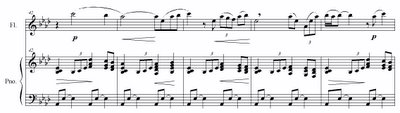 The first excerpt I've posted here is near the end of the second variation. One of the things I like about this variation is its extremely simple bass line (just two notes, which keep repeating, until--but you'll have to visit my website for the rest of the story...) with a simple succession of chords in the right hand and a somewhat stream-of-consciousness meditation on the theme in the flute part. It sounds like this.
In the flute and piano variations, the variation that the first excerpt came from represented a period of rest; although it wasn't long, it had a timeless quality about it, in the sense that it could keep going forever (I think the computer plays it faster than I would--I know; I programmed the tempo; the performer me thinks that the composer me pushes the tempo too much here--talk about being of two minds!). Where was I?
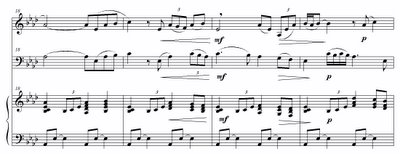 The second excerpt, a transcription of the previous variation, but now for mezzo-soprano, cello and piano, came about when I was setting some wonderful poems by my Aunt Elizabeth. I needed a time of relaxation after a particularly intense text, and happened upon my flute variation. So Gilead came into existence: a wordless song, almost a lullaby, that offers a moment of quiet and healing after the strong emotions of the previous movement. Of the five-movement set of songs (Gilead is number 4), Gilead is the only one to have been performed to date.It sounds like this. The piano part is unchanged; the soprano does the flute part, and the cello either doubles the voice or adds a countermelody.
When my cousin Michael went to Norway for the year, he took another of my pieces, a vocal duet, with him and started teaching it to a choir he is conducting for the year. He wanted me to make some minor adaptations to fit the choir, so I went farther than he asked (not an unusal happenstance) and not only modified that piece, but sent him several other works, including a choral version of Gilead (my third excerpt).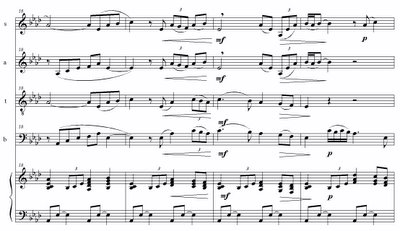 If you compare the three excerpts, you'll notice that each adds a little more complexity, although the piano part remains constant. Much of the choral version still has the two-voice feel of its predecessor version, although there are moments, like right at the end of the excerpt, when voices become more independent. There is still no text, so it is up to the director to find a neutral syllable that works with the choir.This last excerpt sounds like this.
What I found so satisfying is that the connections to previous work actually strengthened the compositional process. It gave me an anchor, something to build from or build toward. I confess that I've done this a couple of other times, with similarly successful results--of course, I'm measuring success to some extent personally. Ultimate success for me comes from my audience, and how much they enjoy the music...and how much my performers (I'm often one of them) enjoy their musical experience.
After all, it's not just music to my ears...
At Lafayette- Orinda Presbyterian Church I had the opportunity to write for a flautist almost every month for a year or so (usually because, although she had been hired, no one had planned what she would play). One month I wrote a set of variations on Balm in Gilead. You'll find a short description of the piece on my website, along with a link to the pdf of the full piece.
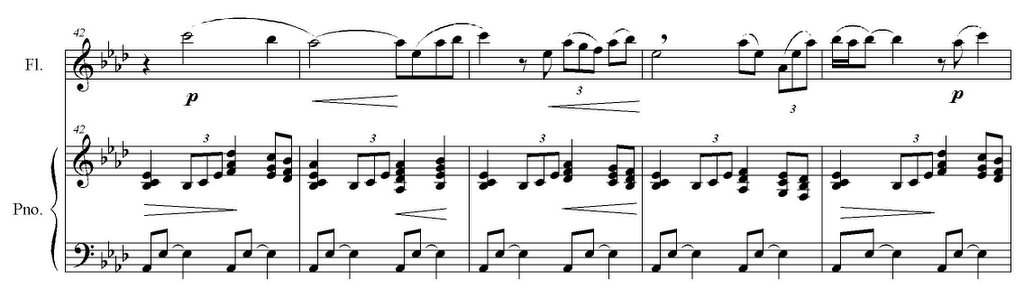 The first excerpt I've posted here is near the end of the second variation. One of the things I like about this variation is its extremely simple bass line (just two notes, which keep repeating, until--but you'll have to visit my website for the rest of the story...) with a simple succession of chords in the right hand and a somewhat stream-of-consciousness meditation on the theme in the flute part. It sounds like this.
In the flute and piano variations, the variation that the first excerpt came from represented a period of rest; although it wasn't long, it had a timeless quality about it, in the sense that it could keep going forever (I think the computer plays it faster than I would--I know; I programmed the tempo; the performer me thinks that the composer me pushes the tempo too much here--talk about being of two minds!). Where was I?
 The second excerpt, a transcription of the previous variation, but now for mezzo-soprano, cello and piano, came about when I was setting some wonderful poems by my Aunt Elizabeth. I needed a time of relaxation after a particularly intense text, and happened upon my flute variation. So Gilead came into existence: a wordless song, almost a lullaby, that offers a moment of quiet and healing after the strong emotions of the previous movement. Of the five-movement set of songs (Gilead is number 4), Gilead is the only one to have been performed to date.It sounds like this. The piano part is unchanged; the soprano does the flute part, and the cello either doubles the voice or adds a countermelody.
When my cousin Michael went to Norway for the year, he took another of my pieces, a vocal duet, with him and started teaching it to a choir he is conducting for the year. He wanted me to make some minor adaptations to fit the choir, so I went farther than he asked (not an unusal happenstance) and not only modified that piece, but sent him several other works, including a choral version of Gilead (my third excerpt).
 If you compare the three excerpts, you'll notice that each adds a little more complexity, although the piano part remains constant. Much of the choral version still has the two-voice feel of its predecessor version, although there are moments, like right at the end of the excerpt, when voices become more independent. There is still no text, so it is up to the director to find a neutral syllable that works with the choir.This last excerpt sounds like this.
What I found so satisfying is that the connections to previous work actually strengthened the compositional process. It gave me an anchor, something to build from or build toward. I confess that I've done this a couple of other times, with similarly successful results--of course, I'm measuring success to some extent personally. Ultimate success for me comes from my audience, and how much they enjoy the music...and how much my performers (I'm often one of them) enjoy their musical experience.
After all, it's not just music to my ears...
Friday, November 25, 2005
Andante Grazioso
While things have quieted a little from my last post, I'm really enjoying preparing for the upcoming WomenSing concert. There's nothing like being able to collaborate with an ensemble that's on top of its game, with an outstanding conductor and piano accompanist. What I'm most enjoying is that the music is challenging enough that I really need to practice every day. I know--I should practice every day anyway; I need a goal or deadline to motivate me--and I am real motivated right now!
Between preparing the organ part of my Christmas Toccata, written for the concert, and becoming more familiar with the various choral accompaniments, including Kirke Mechem's delightful Seven Joys of Christmas (four movements of which I'm transcribing from piano to organ), I have no trouble filling a substantial practice session each day. It's gratifying to see that I'm making some progress, as I retain at leasts some benefit from my previous day's workout.
A challenge that is common for organists is that I don't get much actual rehearsal time on the instruments I'll be playing in concert. So one tries to simulate the sound and the physical setup of the concert locations so as to make the best use of the concert hall rehearsal time. The easiest part is learning the notes; the hardest thing is becoming familiar with a strange console.
And in the midst of all this, focusing on my church position with various upcoming Christmas season activities, as well as--just about as regularly as I breathe--working on a new composition.
There's no shortage of music to my ears...
Between preparing the organ part of my Christmas Toccata, written for the concert, and becoming more familiar with the various choral accompaniments, including Kirke Mechem's delightful Seven Joys of Christmas (four movements of which I'm transcribing from piano to organ), I have no trouble filling a substantial practice session each day. It's gratifying to see that I'm making some progress, as I retain at leasts some benefit from my previous day's workout.
A challenge that is common for organists is that I don't get much actual rehearsal time on the instruments I'll be playing in concert. So one tries to simulate the sound and the physical setup of the concert locations so as to make the best use of the concert hall rehearsal time. The easiest part is learning the notes; the hardest thing is becoming familiar with a strange console.
And in the midst of all this, focusing on my church position with various upcoming Christmas season activities, as well as--just about as regularly as I breathe--working on a new composition.
There's no shortage of music to my ears...
Sunday, November 20, 2005
Allegro Molto
Things have been nicely busy, both musically and personally, over the last several weeks. I've written at least three pieces of music, performed in three concerts, am getting ready for another, and am about to get started on a new composition for my cousin Michael. Beyond that my church position has kept me involved, as I renew acquaintance with familiar organ works and try to regularly add new pieces to my repertoire, and as I work with two musical ensembles that present music in worship each week (and let's not forget preparations for Christmas, which is just around the corner!).
First things first: a musician's gotta have some fun, although not everyone would link "golf" and "fun" in the same sentence! I'm playing at Harding Park Golf Course in San Francisco in the morning. It's a fairly challenging municipal course in a picturesque area near the Pacific coast. Recent activities mentioned in the previous paragraph include:
None of that is really sufficient excuse for ignoring my blog, so I'll try to do better for the rest of the year. I want to look at the pieces I wrote, and offer some comments on writing for organ and piano, as well as the general matter of transcription (my Noel Nouvelet variations were originally written for flute and piano).
I'll have more commentary soon. Be assured that it's certainly been music to my ears...
First things first: a musician's gotta have some fun, although not everyone would link "golf" and "fun" in the same sentence! I'm playing at Harding Park Golf Course in San Francisco in the morning. It's a fairly challenging municipal course in a picturesque area near the Pacific coast. Recent activities mentioned in the previous paragraph include:
- Organist in Faure Requiem performed by U.C. Berkeley University Chorus
- Performer in San Francisco AGO (American Guild of Organists) chapter concert with my And they were filled with the Holy Spirit and Mckee Variations
- Organ/piano accompanist of WomenSing in an interfaith concert in Walnut Creek CA
- New compositions include an organ setting of Jesus Loves Me and two works for organ/piano duo: variations on Noel Nouvelet and Christmas Toccata (the latter to be performed on an upcoming concert of WomenSing on December 4 and 7 (I'm providing organ accompaniment on several works as well)
None of that is really sufficient excuse for ignoring my blog, so I'll try to do better for the rest of the year. I want to look at the pieces I wrote, and offer some comments on writing for organ and piano, as well as the general matter of transcription (my Noel Nouvelet variations were originally written for flute and piano).
I'll have more commentary soon. Be assured that it's certainly been music to my ears...
Wednesday, November 02, 2005
tempo rubato all over again
I blinked and October disappeared! We took a week or so with my Dad in his condo in Hawaii (I did get some golf in among the shopping trips for new bedding and various small repairs). It was a good change of pace. But I didn't write any music, which is almost like saying I decided not to breathe for a while. But music has kept me quite busy, with two active groups at church: between rehearsals, Sunday mornings, putting together practice CDs and leadsheets, and planning for the rest of the year, life was--musically speaking--pleasantly full.
But it's interesting how the calendar can fill up even more when you're not looking...
I played a couple of weddings that I'd had on my calendar for a while; then there was that extra memorial service, a couple of extra meetings, and a couple of upcoming organist gigs with an outstanding women's chorus (WomenSing). And a portion of a concert Monday November 7 sponsored by the San Franciscfo AGO chapter. All of a sudden preparation and practice time start crowding out important things like vegging out, or playing a little golf, or a nice dinner with my spouse (I think we'll next see each other at the dinner table in five days or so).
Am I complaining or bragging? I'm not sure. It's nice to be busy, or rather to have busies that others value. I probably didn't need to say yes this afternoon when I was asked to be a last-minute fill-in for an ailing organist for a performance of Faure's Requiem on the U.C. Berkeley campus this weekend, but I like the piece, it's my alma mater, and it doesn't hurt to improve the bottom line (see how I feel about that in a week or so after this yellow dog Democrat provides cocktail music at a Republican Women's gathering!) (No, I won't play Can't Stop Thinking About Tomorrow--Bill Clinton's theme song, for those of you who don't remember or live on the other side of the pond--but it's tempting!)
All this as a rather lengthy excuse for why time slipped away from me again (thus the title of this post). And yet, in the middle of all that, I found a couple of hours this morning to write a violin and piano piece for Sunday morning--I'll know in another day if the violinist is intrigued enough/has sufficient practice time to work on it this week. And I may soon be working on a compositional project for my cousin Michael. More about these projects and one other soon--
because it's all music to my ears...
But it's interesting how the calendar can fill up even more when you're not looking...
I played a couple of weddings that I'd had on my calendar for a while; then there was that extra memorial service, a couple of extra meetings, and a couple of upcoming organist gigs with an outstanding women's chorus (WomenSing). And a portion of a concert Monday November 7 sponsored by the San Franciscfo AGO chapter. All of a sudden preparation and practice time start crowding out important things like vegging out, or playing a little golf, or a nice dinner with my spouse (I think we'll next see each other at the dinner table in five days or so).
Am I complaining or bragging? I'm not sure. It's nice to be busy, or rather to have busies that others value. I probably didn't need to say yes this afternoon when I was asked to be a last-minute fill-in for an ailing organist for a performance of Faure's Requiem on the U.C. Berkeley campus this weekend, but I like the piece, it's my alma mater, and it doesn't hurt to improve the bottom line (see how I feel about that in a week or so after this yellow dog Democrat provides cocktail music at a Republican Women's gathering!) (No, I won't play Can't Stop Thinking About Tomorrow--Bill Clinton's theme song, for those of you who don't remember or live on the other side of the pond--but it's tempting!)
All this as a rather lengthy excuse for why time slipped away from me again (thus the title of this post). And yet, in the middle of all that, I found a couple of hours this morning to write a violin and piano piece for Sunday morning--I'll know in another day if the violinist is intrigued enough/has sufficient practice time to work on it this week. And I may soon be working on a compositional project for my cousin Michael. More about these projects and one other soon--
because it's all music to my ears...
Monday, October 10, 2005
alla breve
Just a quick note (thus the title) as we try to finish packing before midnight for a short trip to Kauai: this last Sunday at church was quite satisfying, both because the service came together well and seemed to have meaning and import for many in the congregation and because I had three pieces performed (thus satisfying my composer's soul ).
[For those not up on their music notation, "breve" refers to a half note, a l'Americaine--the oval with a stem going up or down--in a piece of music fast enough that it's easier to count half notes than quarter notes--filled-in ovals with stems--but the whole point of the title is that I don't have any more time--but do read the rest of the note after clicking on the link below.]
The service was built around our contemporary, guitar-based Praise Team. I still wanted some organ presence, so I played a meditative piece that references How Great Thou Art (O Store Gud) for prelude, and wrote a variation of the closing song, Shout to the Lord, for postlude. At the offering, my wife Marianne sang my setting of the ubiquitous Footprints in the Sand poem of greeting card/wall poster/coffee mug/et cetera fame. I provided some background vocals and played piano (a quasi finger-picking style--as much as the piano can handle that particular guitar idiom).
We're down to the wire, and may soon start intruding on sleep time, as we do our usual last-minute rush to the finish line. We still have 9 hours until we leave for the airport: plenty of time to pack...and at least nap a couple of hours...and although the packing is not my favorite part of the trip, there is plenty else to look forward to that is...
music to my ears.
Thursday, October 06, 2005
a short note
Yesterday was a very productive day. I completed two new pieces of music. One, an anthem version of the lds hymn Awake, Ye Saints of God, Awake!, I had started the previous evening, writing about half of the piece. I got up early the next morning, put in a couple of hours, and had a finished piece. I'm taking it with me today to see if the organ part works on an organ (it sounds fine through my computer's speakers, which isn't saying much).
The other piece, a tocatta-style chorale prelude on Shout to the Lord, came about as a result of my trying to find some organ music to fit in with Sunday's service, which features the guitar-supported Praise Team. I wanted to have something that harkened back to traditional for those who like the usually more even mixture of styles in our service, and yet I didn't want the organ to seem as though it had no connection to the rest of the service. I already had a prelude: a reflective setting of How Great Thou Art, which I wrote a while back. None of my existing music seemed to do for postlude. Rather than keeping digging until I unearthed something, I impulsively decided to write a piece based on the closing song.
The other piece, a tocatta-style chorale prelude on Shout to the Lord, came about as a result of my trying to find some organ music to fit in with Sunday's service, which features the guitar-supported Praise Team. I wanted to have something that harkened back to traditional for those who like the usually more even mixture of styles in our service, and yet I didn't want the organ to seem as though it had no connection to the rest of the service. I already had a prelude: a reflective setting of How Great Thou Art, which I wrote a while back. None of my existing music seemed to do for postlude. Rather than keeping digging until I unearthed something, I impulsively decided to write a piece based on the closing song.
I gave the church secretary my title, after playing around a bit on the organ and developing an opening idea. I'm trying the finished piece out today, so I'll report on it soon.
It was nice to have cousin Michael drop by, even if he wrote me a note directly rather than commenting. I expect to have a post from him soon about his musical and other adventures in Norway (far from his usual San Francisco haunts).
As usual, all this is music to my ears.
Friday, September 30, 2005
simple is not easy
In my post earlier today I spoke of a new piece of music I wrote this morning: simple, 4-measure-long repetitive bass line, a simple 1-measure pattern for the left hand, and a playful melody in the right hand. Did I mention the piece was written for organ? The feet do the bass line. It turns out that simple is not necessarily easy...
I had a practice session this afternoon for a wedding, so I brought my new piece along. I really needed to do this, since I am scheduled to play the piece on Sunday. Yeah, I know I'm doing it backwards: I first schedule me to play a piece that doesn't yet exist, then I write the piece and scramble a bit learning it so I can do justice to the music! I thought I had it made this time. I deliberately stayed simple. But it turns out that fitting simple things together--they occur concurrently--results in a sum that is more complicated than the individual parts would suggest.
I had a practice session this afternoon for a wedding, so I brought my new piece along. I really needed to do this, since I am scheduled to play the piece on Sunday. Yeah, I know I'm doing it backwards: I first schedule me to play a piece that doesn't yet exist, then I write the piece and scramble a bit learning it so I can do justice to the music! I thought I had it made this time. I deliberately stayed simple. But it turns out that fitting simple things together--they occur concurrently--results in a sum that is more complicated than the individual parts would suggest.
I suppose that, if I just wanted to slop my way through, it would be no big deal. But I wanted the piece to be expressive, and on an organ that means that articulation--whether a note is played short and crisp or smooth and connected to its neighbors--is real important.
So it turned out that my simple piece (less than and hour and a half to write almost 4 minutes of solo organ music)...wasn't simple. I've known about that contradiction in other domains--a good children's book or other art for children can be quite challenging to create. Writing an interesting piece for a beginning musician is hard to do--you don't want to fall into cliche or mindless sound.
The piece sounds neat! (What else would I say?) It's better than the mp3 I made from the notation file. I'm looking forward to another practice session tomorrow, as I still have a couple of coordination problems (one hand plays smoothly while the other plays crisply as the bass continues its relentless step - step - step), but I think I'll be able to iron them out. I'll play the piece as part of my wedding prelude (generally 30 minutes of music before the ceremony itself starts) so that its official premiere will go smoothly; I would like to work out any first-performance jitters as well as offer what I hope will be perceived as something special--assuming that anyone even notices!
As usual, it's music to my ears...
Sunday's Coming
The dilemma of a church organist: Sunday's coming. There's always another Sunday, or a wedding, or memorial, or other special event to prepare for. And somewhere after Monday I realize I need another prelude (postlude/offertory). And there's not much time! Theoretically, of course, I practice weeks ahead. But organ playing is a rather practical sport, not long on theory.
I had this bright idea to ask a flautist in the congregation if she would like to play one of my settings of Jesus Loves Me. We're focusing on children this Sunday in conjunction with World Communion Sunday, and JLM is one of the hymns. She liked the idea, but the timing wasn't quite right in her life. In the meantime, I'd committed to JLM in the bulletin. So I got up this morning and wrote down what's really an improv on the tune.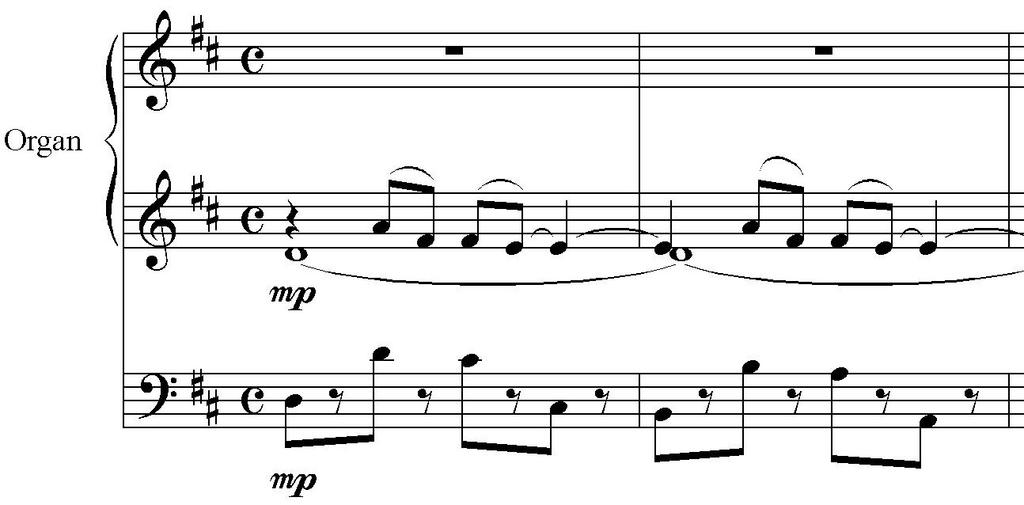 I started with a walking bass. My example shows the first half of the pattern, which just keeps repeating. [Note to Dan and others who like to hear things: here's the link to the mp3 of the whole piece.] The left hand has a simple pattern based on the first four notes of the tune. It also keeps repeating. That didn't take long! Now all I need is a bit of melody.
I decided to ornament the melody a bit. Enough so the tune gets elaborated, but not so much that the tune gets lost in the lettuce. Or broccoli. Or salad dressing. Whatever. The tune starts quite simply, as my second excerpt shows. Except for the first two notes, this first piece of melody presents the tune pretty straightforwardly. In order to make things more interesting (at least for me as composer) I decided that each each chunk of melody would be responsible for four measures, even though in its original form it is only two measures long. And then I made the measures four beats long, rather than the two of the original. It meant I had to figure out how to fill more time, and yet make sure that the connection of the material I wrote to the original tune was clear.
There's an interesting musical problem inherent in the procedure I applied here: there's no real harmonic progression or direction. Or rather, the walking bass implies motion, as it heads down the scale, makes a slight turn, and begins again just as it reaches home. But while the bass suggests motion, the sustain note in the left hand and the short repeated rif suggest a kind of stasis. Even with all the motion of the bass, and a fairly active melody line, there's almost a timeless aspect to the piece.
The lack of harmony and constant rhythmic repetition of the bass and left hand places the responsibility for the shape of the piece firmly on the melodic line. I haven't had a chance to practice the piece yet, but I think that I'll have to focus on the melody to keep the piece moving--or is it enough that these elements are just there? Although my recording suggests only one tone color for the melody, I have in mind alternating between a flute and a reed sound.
I gotta tell you that it felt good to be doing this again: write a piece Friday morning that I'll play on Sunday (well, I got the left hand/bass ideas Thursday evening right before choir practice). I'd been a little down about the rather reduced organ I now play, compared to the instrument at my previous church. Clearly, size is less important than making use of what you've got...
Which is, of course, music to my ears.
Subscribe to:
Posts (Atom)